Well my attempt at capturing the seminal events that have occurred in the long history of the world is finally published. It is called “World Events: From the Big Bang to Today”.
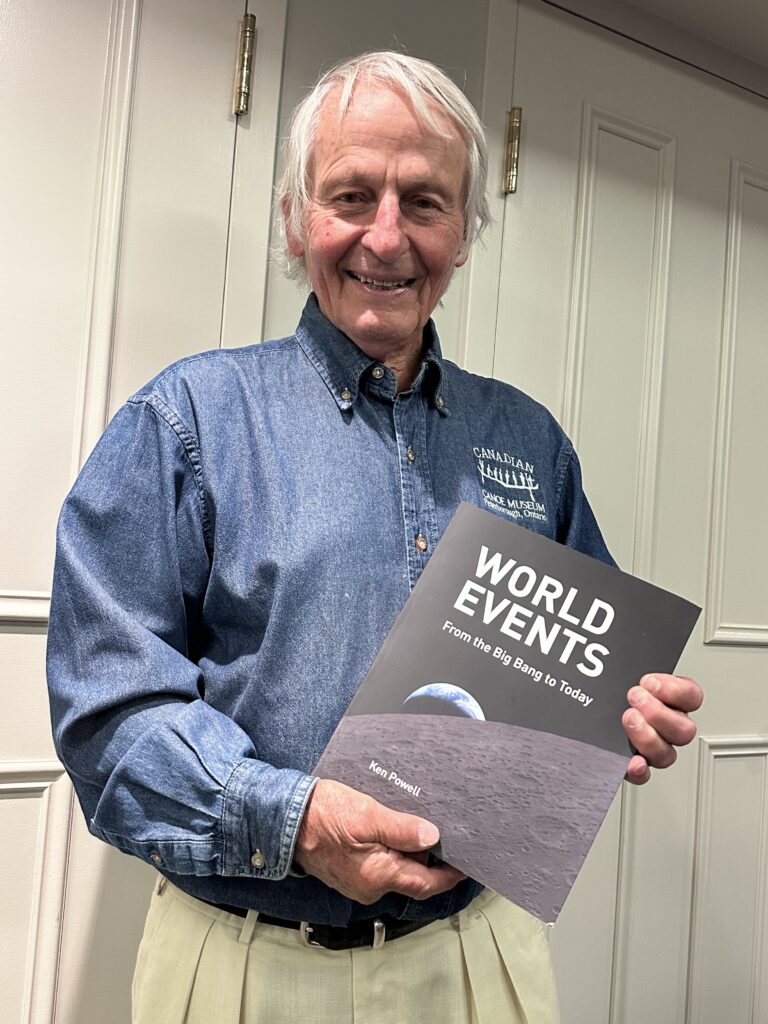
I have decided that I will give a copy to a few of my close friends. Some have told me they would like to pay me for it. I have decided that the money I receive from those that do will be donated to the Canadian Canoe Museum. (In so doing I will be the recipient of the tax receipt.) I have thus put a retail value on the book of $40.
Over the next month I will begin to distribute this book. You will hear more on this in the coming week.
I did not start off to do this. It evolved and has taken over four and a half years to complete.
History can be organized many ways, including culturally, politically, territorially, thematically, and chronologically. I have chosen the latter. In so doing, this has helped me sort out and compare the order of important historical events.
Interesting insights are possible when looking at history this way. I have found patterns presented themselves in unusual and helpful ways when observing what disparate events were taking place in certain time periods. The chronology unmasked revealing insights that a mere focus on themes or geography or politics disguised.
My criteria for inclusion of an event (or idea or person) was based on two things. First, did it have impact and was that impact over a long period of time. Secondly, did it relate to the present; did it initiate trends that are important today.
To be a balanced citizen of the world one must be capable of understanding important historical issues or themes. I truly believe your cultural and general historical knowledge index will rise substantially If you dive into these pages.
Because I’ve been writing a blog for the past eight years, one of my intentions was to identify and eventually write about broad themes and patterns that emerge from examining history in this fashion. (This has already commenced, as you can see by such pieces as the serious issue of nuclear proliferation which can be found at: https://powellponderings.com/themes-and-patterns-emerging-from-a-scan-of-history/.)
If you go to page 12, I identify 24 such themes. They go from the risk of nuclear weapons, to the impact of AI, to demographic realities, to wars, to the clash of governing strategies, to belief systems, etc.
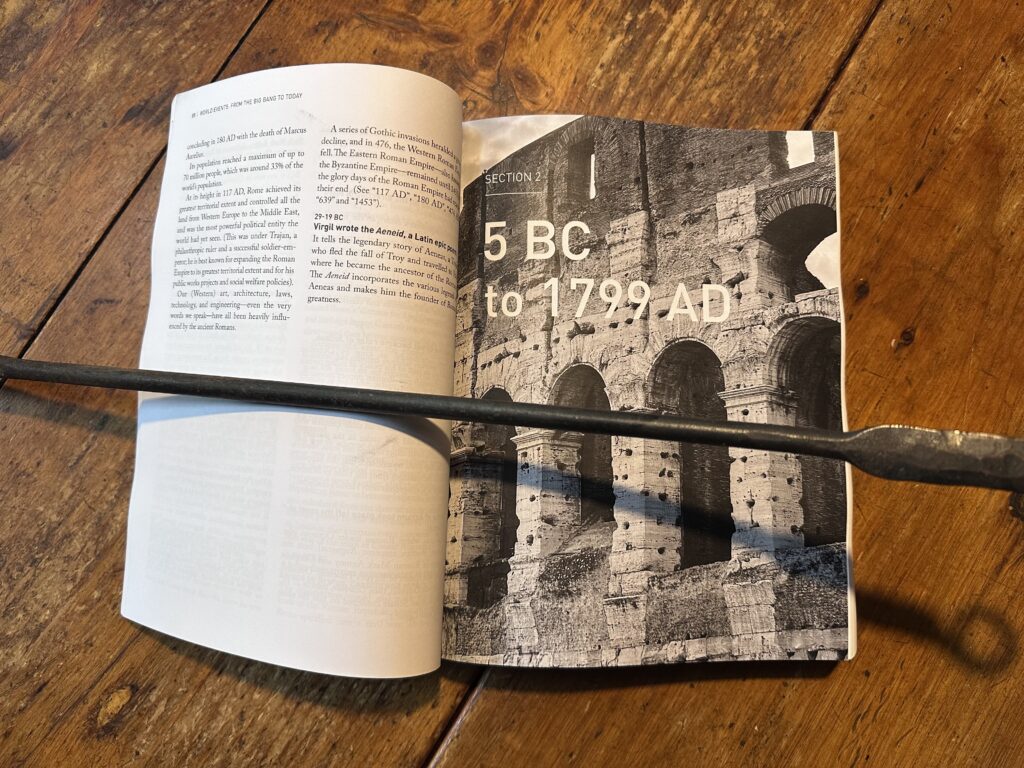
In this book I have not shied away from opinions. You will find many “personal asides” where my years of travel throughout the world (eventually encountering over 140 countries) has provided on-the-ground perspectives. My judgement here was whether my personal connection to the entry added to the understanding, and perhaps even gave it some colour and character and personal feel.
I’ve tried to let the history be my guide and take me there. You might not like what “there” is, but that’s history. If you wish more positive assessments of Trump or Putin for example, you may want to put this book down.
On the subject of Trump, like many I find him an odious person and this book does not shy away from that fact. But regarding history and its value, I find his view deeply flawed. Thomas Homer-Dixon (who is executive director of the Cascade Institute at Royal Roads University and professor emeritus at the University of Waterloo) states that Trump’s behaviour will probably send humanity in an extraordinarily perilous direction for a number of reasons, but the first is ignorance.
He states that Trump and many of his advisers, and a large slice of his followers are contemptuous of expertise, especially credentialed expertise; they’re ill-informed about history and oblivious to scientific fact. But they’re nonetheless entirely persuaded of their brilliance. That’s a potentially deadly combination, because genuine expertise still matters, a lot.
One may not realize this, looking at the page count, but I have tried very hard to keep this to one book. While this contains nearly 3,000 events/dates, there are of course an enormous number not included. There was an inherent pressure to add more, both in the number of events but also the words and debate behind the event. However part of its usefulness is what I have not included. While long, I feel it is almost lean and to the point for the broad sweep of time and events it covers.
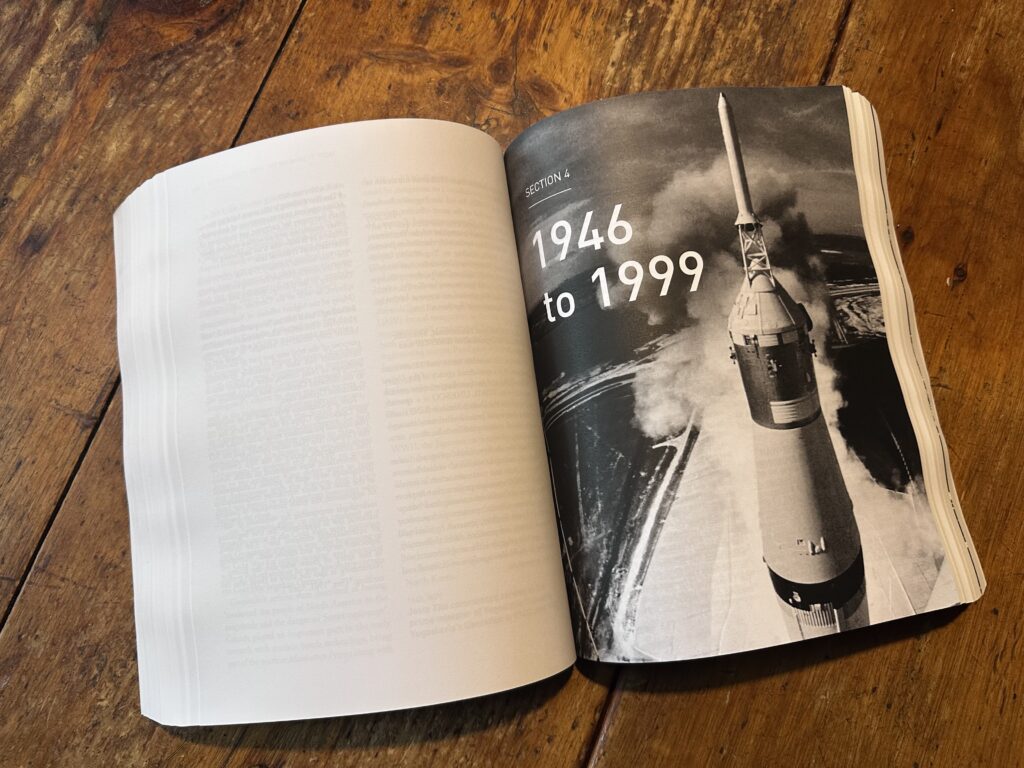
I do not expect, or even suggest, that this document be read in a traditional fashion, from start to finish. You will find many surprises and tidbits you never knew. I certainly was constantly delighted in my discoveries during the period it has taken to assemble.
I do recommend that the introduction be tackled – and then one can be off to the races and curiosity will take hold. Some date links from item to item have been provided to aid in pursuing subjects with common themes.
I am confident you will find it interesting, educational, and thought provoking. I thank you in advance for this exploration. It’s not a small gift to give a writer.
Footnote:
Why history is important:
* It gives us context – and power and, importantly, involvement. Historical knowledge gives us roots: a context for our existence. Individuals who lack that context, lack a significant element of self-understanding but also an understanding of their relationship with the rest of society. Along with this appreciation of context comes an ability to interrogate evidence. Powerless people become easy targets for exploitation, propagandizing and manipulation, particularly by those who appear to offer a membership to a group or cause. Historical knowledge is power.
* It allows us, forces us, to be critical thinkers. In the age of “fake news” engaged citizens need to be culturally literate, critical thinkers. It makes sure we don’t tell a story starting in the middle, as we need to know the history to understand how we got here. It provides nuance in this oversimplified era of brief sound bites (and 280 characters in the text content of a Tweet).
* It allows us to learn, particularly how the past influences the present. Regarding whether Putin would still have gone ahead with his “special military operation” if he had known how it would turn out, Hu We, a political scholar based in Shanghai, has said “History does not entertain ‘what ifs,’ and what is lost can never be regained. We can only learn from the lessons, try our best to not cling obstinately to our course and to never repeat past mistakes. What is the most tragic is to witness a nation that does not remember its past mistakes.”
* Cultural literacy is part of the objective. To be culturally literate is to understand the history and ideas that underlie a culture, and to be able to converse fluently in the allusions and informal content of that culture. In other words, to be educated.
* It engages in important debate regarding historical continuity. Currently there is a lively and important disagreement whether the past is a good guide to our future (see the Snyder quote).
* It helps us focus on who tells the story. This is important as it helps determine political, cultural and gender influence and the potential for bias. As history is about stories, the validity and background of the raconteur is important.
* It can enable our institutions to develop adequate responses to external challenges. As the author Trilby Kent said in a Globe & Mail Opinion piece Oct 22, 2022 “In an era of environmental change, rising inequality, and seismic shifts in the international political arena, we need to understand how our institutions have developed in order to understand why they don’t always have adequate responses to these crises. History gives us this power. No other subject helps us understand so comprehensively what it is to be human.”
* It helps in making sense of the daily news. Having a historical sense helps make sense of the often complex events, issues, relationships and patterns that bombard us daily.
* History helps us become familiar with one another, which should help in growing together as opposed to the dangers of being apart. As historian Arnold Toynbee said in his famous A Study of History, “Mankind has not yet been united politically, and we are still strangers to each other in our local ways of life, which we have inherited from the times before the recent ‘annihilation of distance’. This is a terribly dangerous situation. The two World Wars and the present worldwide anxiety, frustration, tension, and violence tell the tale. Mankind is surely going to destroy itself unless it succeeds in growing together into something like a single family. For this we must become familiar with each other, and this means become familiar with each others history, since Man does not live just in the immediate present.” This was written in 1972; more than 50 years of somewhat anxious history has since passed, and his words and the hope behind them, while at times somewhat Panglossian, seem relevant.
* History means curiosity: as human we should be curious about our past. Toynbee argues for studying history simply because we should be moved by curiosity. As he says, curiosity is one of the distinctive faculties of human nature.
* History makes us search for truth, for accuracy. The teaching and study of history becomes an opportunity to demonstrate how history must be told truthfully and accurately. Part of this is the search for evidence from primary sources and experts, not just websites. Being critical consumers of social media is one desired outcome. The historian Will Durant said: “most of history is guessing, and the rest is prejudice”. A corollary can be…
* History can also provide a rebalancing of truth from the game of PR fiction or political intrigue or simply issues that governments feel the need to keep secret. “History is the best teacher, but its lessons are not on the surface,” observed Kenneth Thompson, an international-relations scholar.