Introduction
The first thing to say about my journey to India in January was that I did it with my two sons, Brendan and Dylan. That fact is very important. It implies that we could get along well over the intensity of the journey, sleeping all in the same room and spending many hours in cars and trains and planes.
So here is Dylan on the right (not the far right), who lives in Whitby and is VP International, Mary Brown Chicken with his older brother Brendan who lives in Toronto (plus near Frankford) and is president of Bspoke Realty.
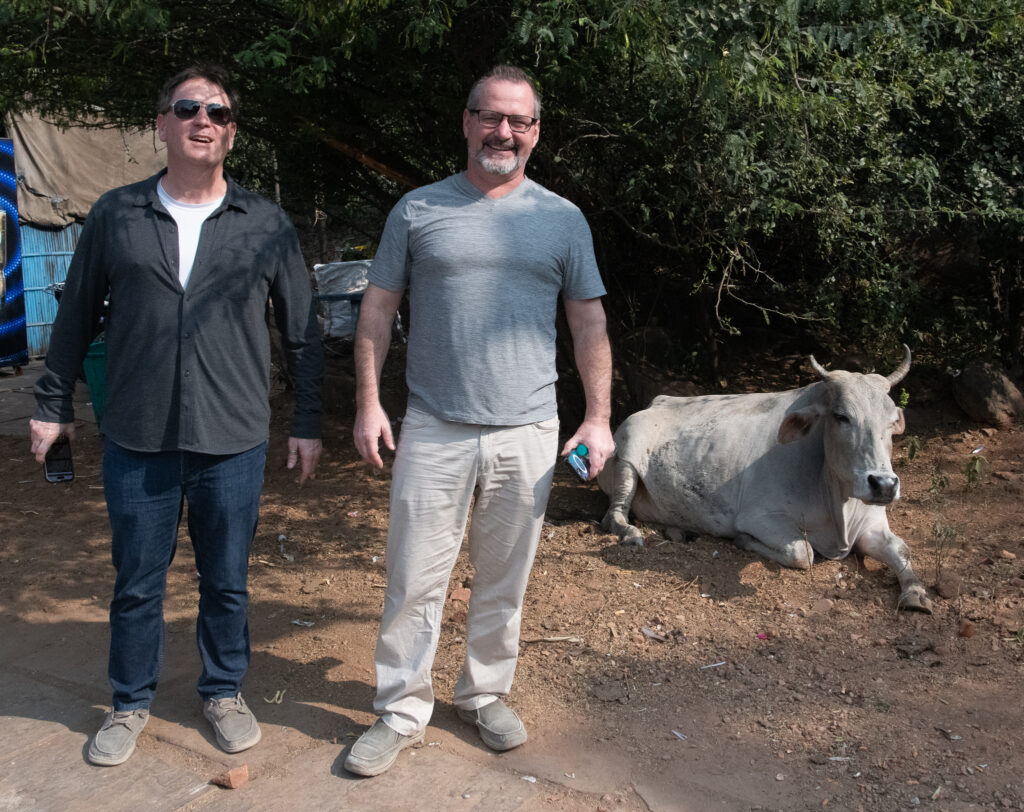
But it was much more than negotiating a tricky journey, it included hours of conversation on a “no subject barred” format; it meant me leaving much of the travel choices to their management (a task I generally have taken on); and it permitted me to actually physically do the journey because they helped me do it. India is not a country that’s easy for people with a knee that refuses to bend, thus I found my hand was often on one or the other’s shoulder or grabbing their arm going up or down steep or awkward places, generally with no railings.
While I have travelled in India many years ago (back when Mumbai was called Bombay), my travel was confined to the south. I have thus been curious about India’s north, it connections to Pakistan, the Sikh area, the Taj Mahal, and the huge mass of activity around the capital Delhi.
In this main blog a consolidated version of the journey is provided, in which I have chosen three cities/sights (Delhi, the India/Pakistan border “ceremonies”, and the Taj Mahal) plus four themes (pollution, traffic, food, and the story behind introducing the Mary Brown Chicken franchise into the country) to provide the reader a sense of the journey.
A car was essential to get to places we wanted to reach. But we made a sensible decision when planning this trip that we would not drive ourselves. So for much of our journey we hired drivers and cars. There were four in total, and the individuals were competent, and while not tourist guides, they did provide the occasional local bit of information.
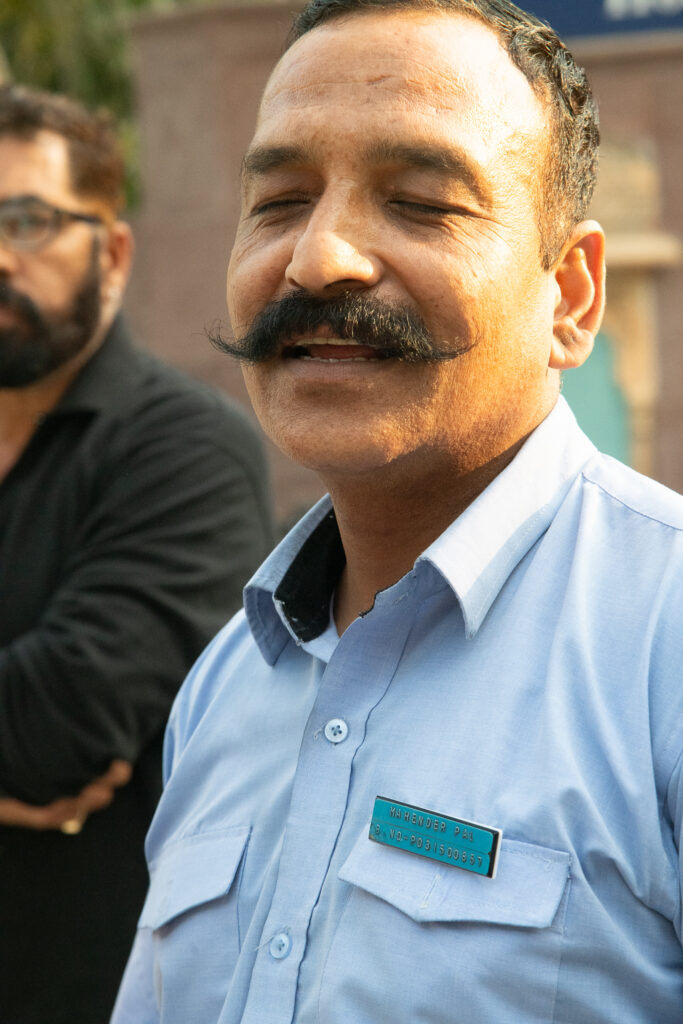
Here is Mahender who picked us up at the Delhi airport (moustaches and beards have been elevated to an art form in India).
In Attachment A, https://powellponderings.com/india-travels-daily-journey-attachment-a/, I have encapsulated my trip in the order of how we did it. It was a convoluted and quite full journey.
Some geographic, economics, demography and religion issues are dealt with briefly in Attachment B, https://powellponderings.com/india-travels-geography-etc-attachment-b/, and current India/Canada political issues in Attachment C, https://powellponderings.com/india-travels-india-canada-politics-attachment-c/.
The journey started in Delhi and went in two arms from there, over the course of 16 days. Here is a map that highlights this. It is interactive, so you can click on any blue or red dot, and a brief summary of what we did pops up. This is the guts of the trip which, as I said, has been outlined in Attachment A.
India Travels — The Powells
North Jodhpur → Delhi → Amritsar (Wagah Border) → Delhi → Agra (Fatehpur Sikri) → Delhi → Jalandhar → Delhi
1. Delhi
There is no dodging it; you can’t talk about India without dealing with its political centre and capital.
Delhi is located in north central India bordered by the state of Haryana on three sides and the state of Uttar Pradesh to the east. It sits in a basin between the Himalayas (about 160 kms away) and Aravallis mountains where temperature inversions trap pollutants near the surface. It straddles the Yamuna River, a tributary of the mighty Ganges.
Delhi is simply enormous. And here’s the thing: trying to nail down its size is tricky. There is New Delhi, the official capital of the country, which is located within the larger National Capital Territory (NCT) of Delhi.
The NCT geographically is almost square (52 kms by 49 kms). The population is 22 million, but the metropolitan area has been estimated at 35 million, making it the second largest city in the world behind Tokyo. But the city doesn’t really stop; it goes on and on, so what is size, really. The metropolitan area has more people in it than all of Canada.
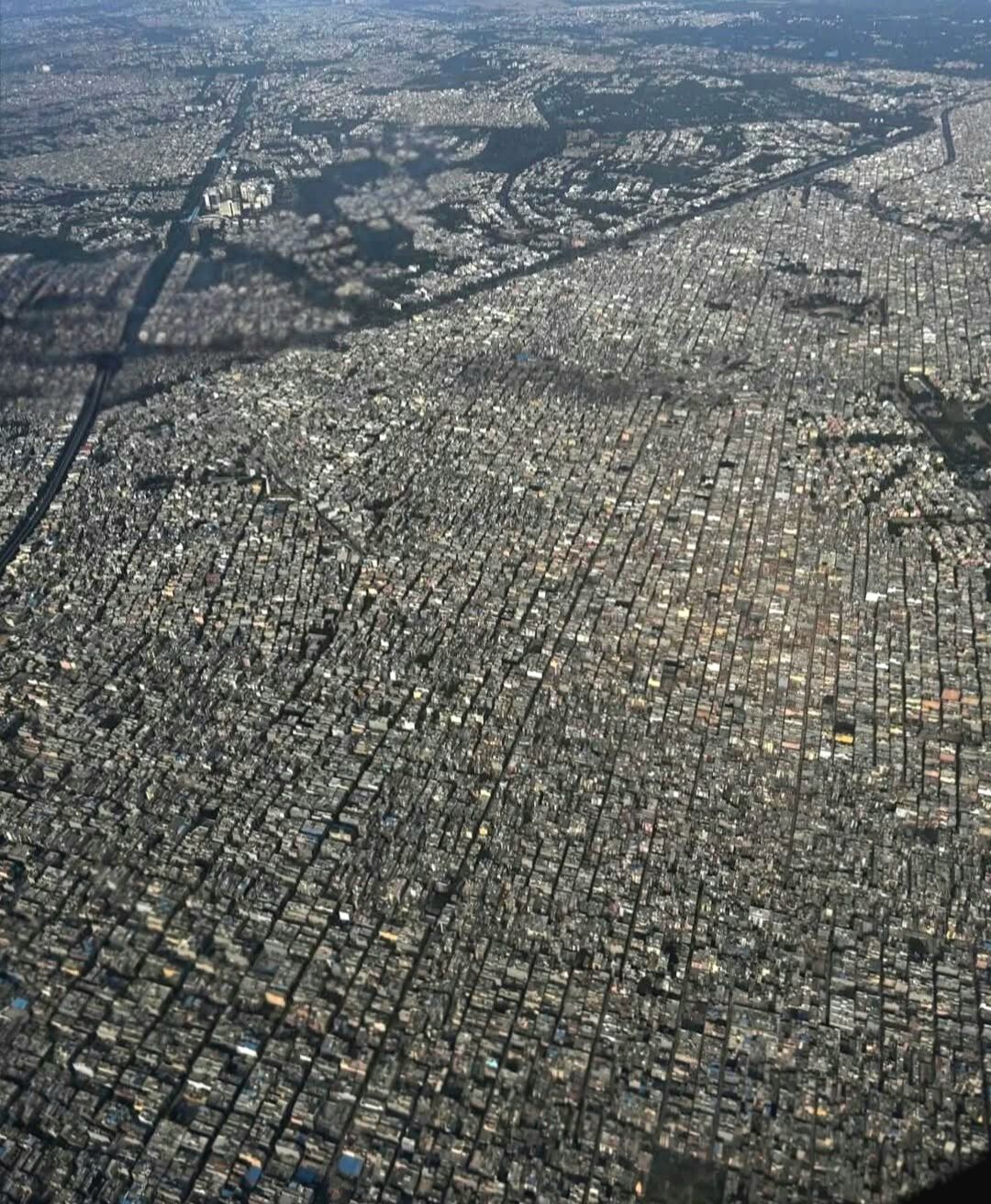
We were in and out of Delhi several times, and it always presented long, noisy, chaotic drives, whether we were going to or from hotels, restaurants, the airport or railway stations. We were also there when it was reasonable temperature-wise, i.e. 8 to 14 °C. In the summer it goes way up, with average temperatures near 40 °C.
Delhi is a good segue to a tricky subject for a country.
2. Pollution in the air and garbage on the ground
India has an enormous problem: the air people breathe and the garbage that they see are nothing short of dreadful.
Hanging low in the skies, the smog is constant, and you see a sort of dust gather on the surface of vehicles, outside tables, etc.
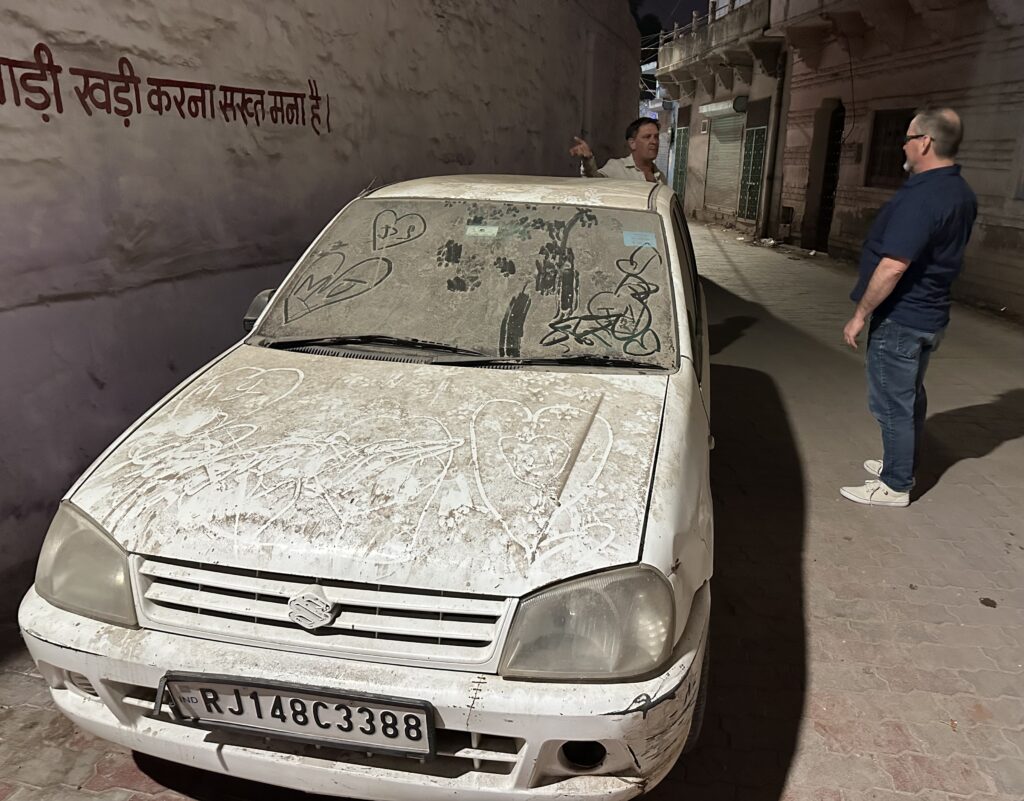
13 of the 25 cities worldwide having the highest level of particulate matter (PM), which is a measure of air quality, are in India. The country has 6 of the 10 most polluted cities globally (and Delhi tops the chart according to a recent report from Switzerland, based on an air quality monitoring database, IQ Air). Since November, Delhi’s air quality has hovered more than 20 times the limit recommended by the World Health Organization.
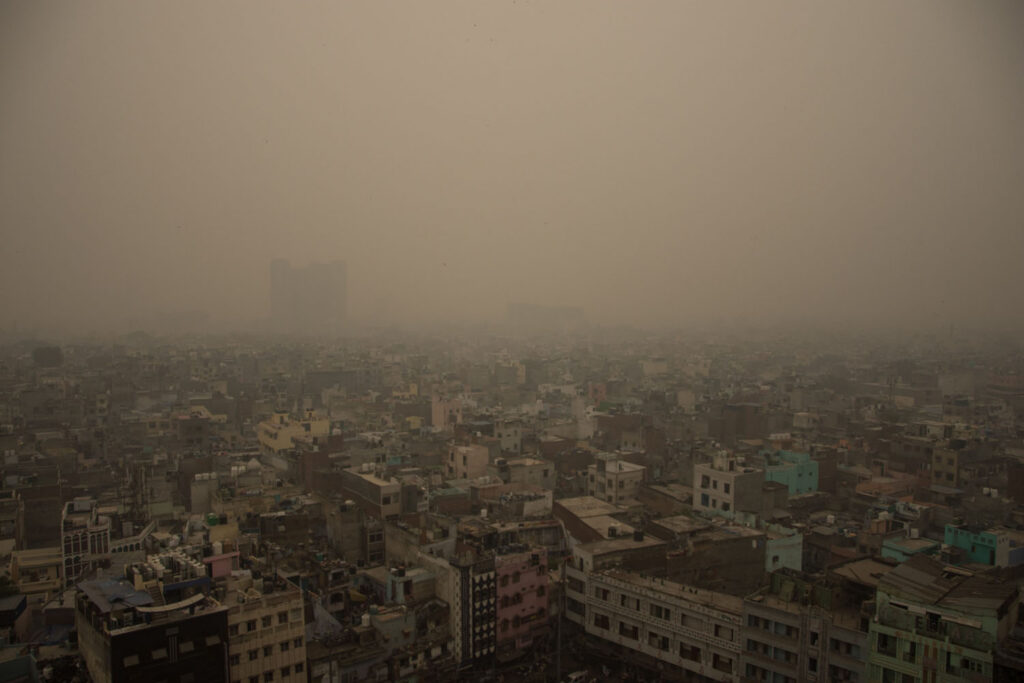
Even as one travels out beyond Delhi, one senses the irritation in the eyes and throat. Inhaler sales have never been higher. Pulmonologists speak of longer coughs, more wheezing, more first-time asthma diagnoses. They also say that India has the world’s highest death rate from chronic respiratory diseases and asthma.
While visible particulate matters, invisible pollutants like ground-level ozone, nitrogen oxides and volatile organic compounds are also a problem. They can harm respiratory and cardiovascular health even when skies appear relatively clear.
The sources are many: vehicles and traffic congestion (see next), including road dust, industrial activity, diesel generators, construction, waste burning, and one that is huge – crop burning, one of the biggest causes. In the states of Punjab and Haryana, the north-westerly winds drag the result of crop burning into the city. There are two other sources: the burning of effigies during Vijayadashami, and firecrackers during Diwali, the Hindu “Festival of Lights”.
As our visit to the Taj Mahal, India’s most sacred tourist destination, underscored, no spot is sacrosanct. My photographs tell the story. Out of a hotel room in Amritsar 10 stories up, one can look out and the horizon disappears into a greyness of seeming fog.

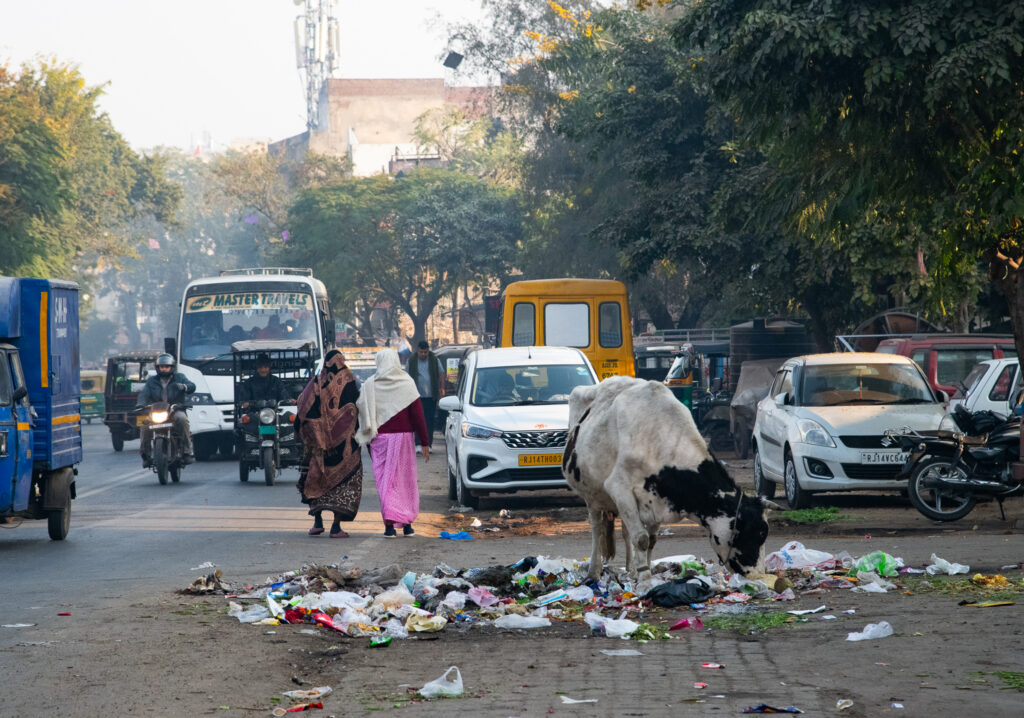
The other kind of pollution – that of garbage – is both visual and smelly, as well as unhealthy. It is everywhere, on the streets, between buildings, strewn in front of shops. A lot of it is non-decomposable trash. To me, it seems like what it would be if I took my weekly bag of garbage at home and dumped it out in front of my house, and did that week after week without cleaning it up.
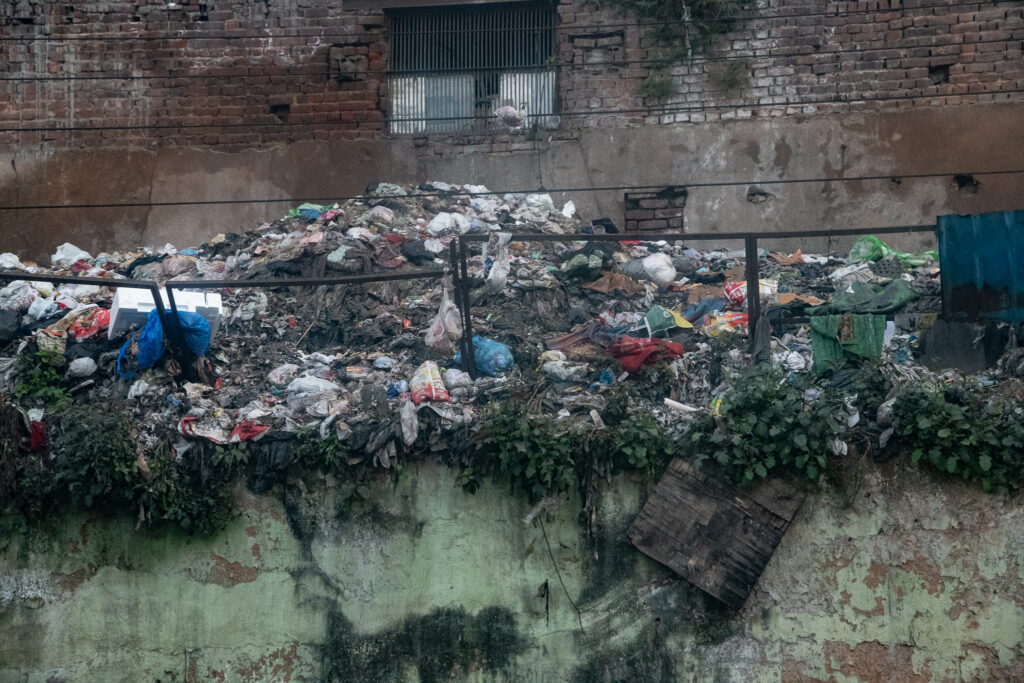
While, as I said, it is visually displeasing, it also becomes a source of animal (and then human) infection. Apparently cities lack efficient waste collection, segregation, and disposal systems, but certainly trash simply does not get picked up. There also seems to be a shortage of public garbage bins.
Regarding cause, certainly rapid population growth and urbanization have brought significant challenges. I was told that people maintain high standards of cleanliness inside their homes (and I know from my limited exposure that this is true) but view public spaces as “no one’s responsibility”. Some scholars trace this to a colonial legacy where public spaces were seen as belonging to the government rather than the citizens.
Is it that “dirty work” is the duty of others rather than a shared civic responsibility? Is there something about the old caste system ingrained within Indian society, where no one really thinks beyond his/her own small caste group?
And India does have a practical problem: the country still relies on coal for three-quarters of its electricity generation.
3. Driving/traffic, and animals
It’s fast and furious and disorganized mayhem, with pushing aggressively into traffic a common, and as I soon realized, necessary tactic. Personal space: forget about it! If you didn’t push you wouldn’t get anywhere; as well, you’d be shamed by those that are trying to get somewhere.
The rule base seems to be universal: wedge in where possible (and often seems impossible), tail very closely which leaves little room for others to wedge in, push again, squeeze some more, honk of course as you are doing this, ignore anything to do with those who constructed the road like painted lines defining lanes, or protecting spaces. One-way signs are often disregarded if a driver thinks he can advance to his advantage.
Remember also that for all you right side drivers, in India they drive on the left side of the road.
Everyone drives with their horn. There is a constant blaring from motor bikes, tuk tuks (called auto-rickshaws), cars and trucks (with diminishing order of importance; size rules).

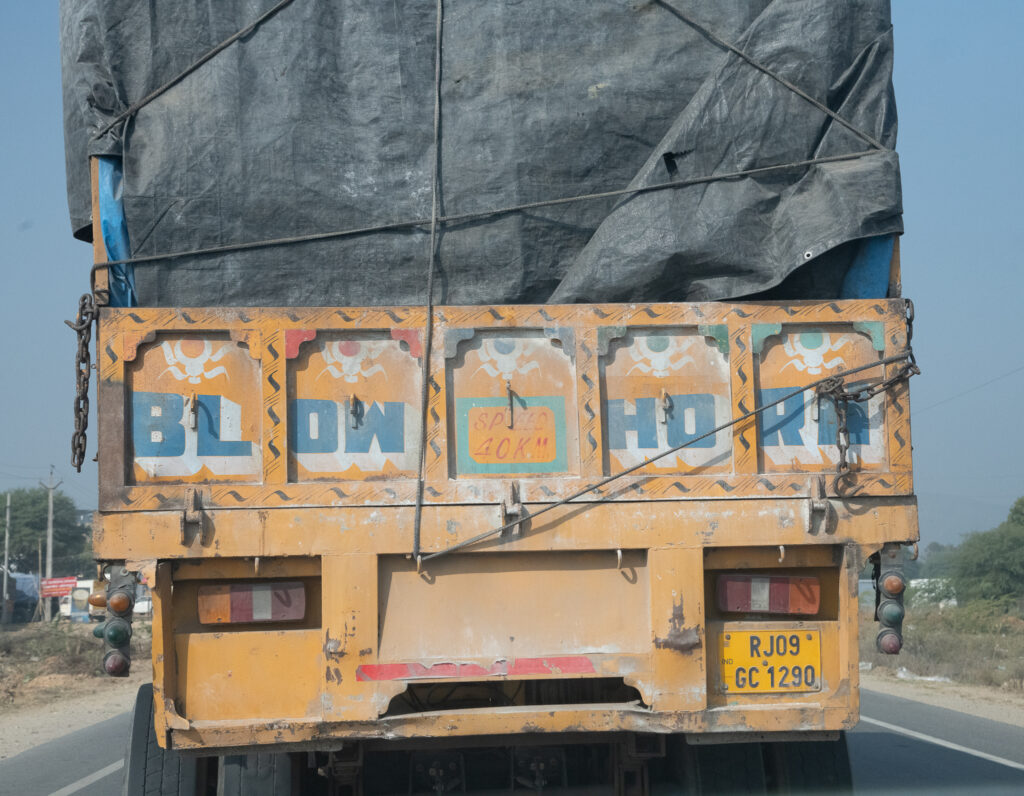
A common sign on the back of trucks is “Blow horn”. They want you to let them know your intention. If you don’t honk, you don’t exist. Thus we have an insidious kind of pollution: noise.

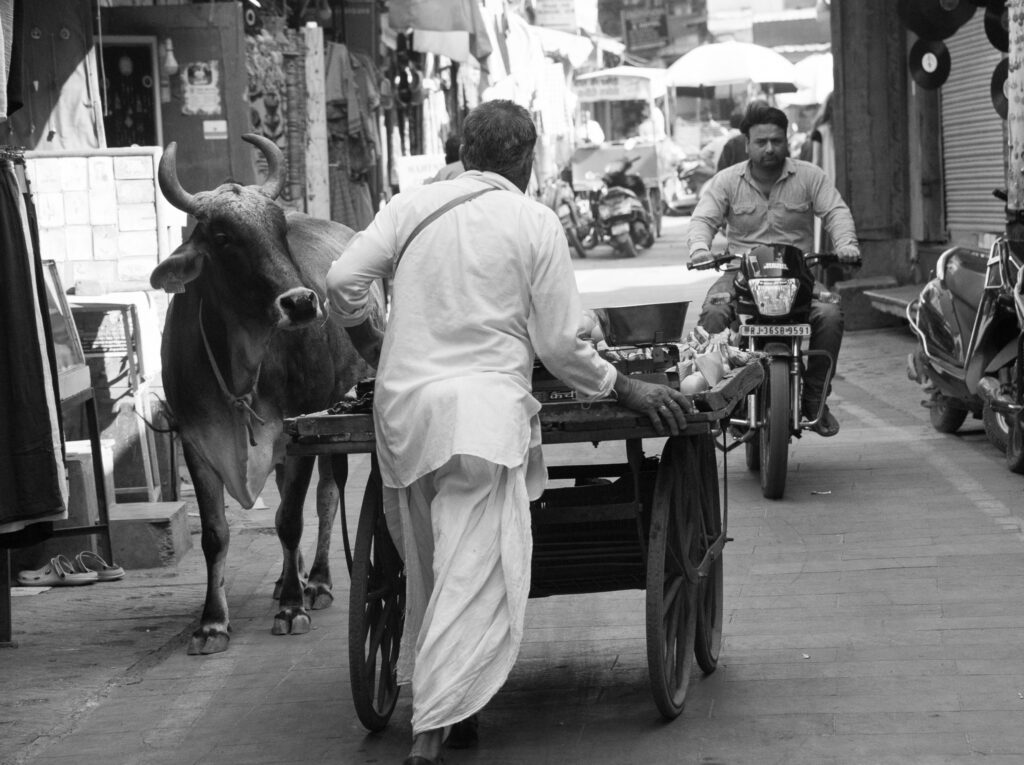
Now throw in two other things: cows and dogs. The cows wander everywhere and certainly out into the road. It makes no difference in which direction the traffic goes as cows have no direction. Even on highways where the traffic is going at quite a clip, cows are sauntering everywhere at their own slow pace. They are also fond of poking into garbage on the roadside.
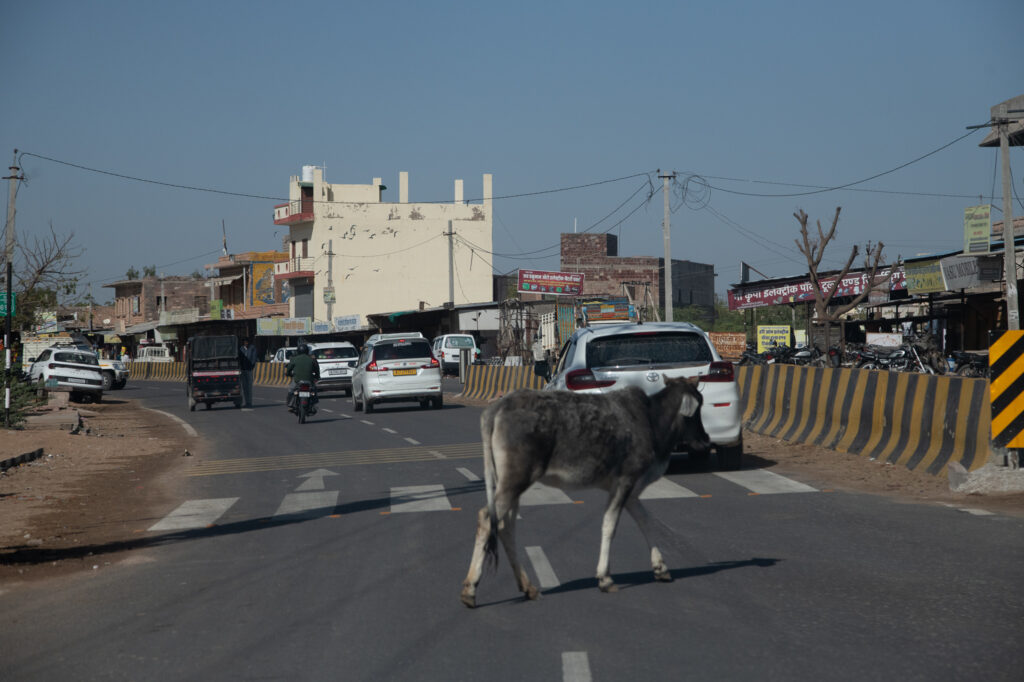
Remember cows are considered sacred to Hindus (and eating beef is a strict taboo), and there are over 900 million in India – Hindus, that is. (Estimates indicate there are over 5 million stray cattle – cows and bulls – wandering freely in India.) This sacred status is primarily within Hinduism and not generally shared by other religions in India. (See Attachment B: https://powellponderings.com/india-travels-geography-etc-attachment-b/.)
Then we have the dogs; they are also everywhere. Some even sleep in the middle of traffic, seemingly unconcerned by the chaos around them.

Other animals appear from time to time: goats and sheep, and even camels, trying to emulate the cows, but there are enough cows and dogs to create the madness.
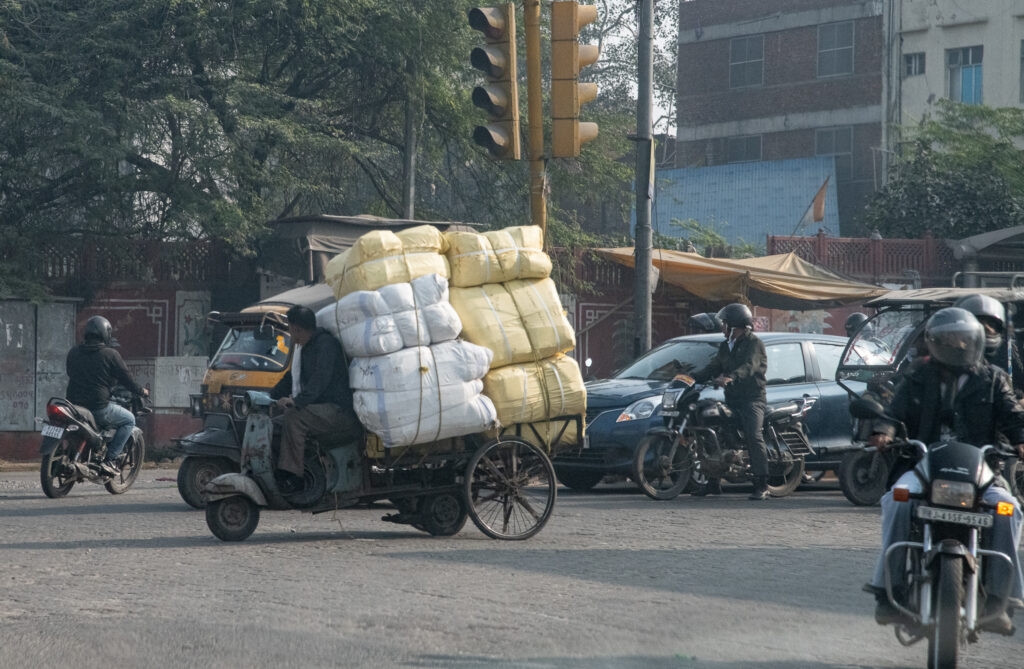
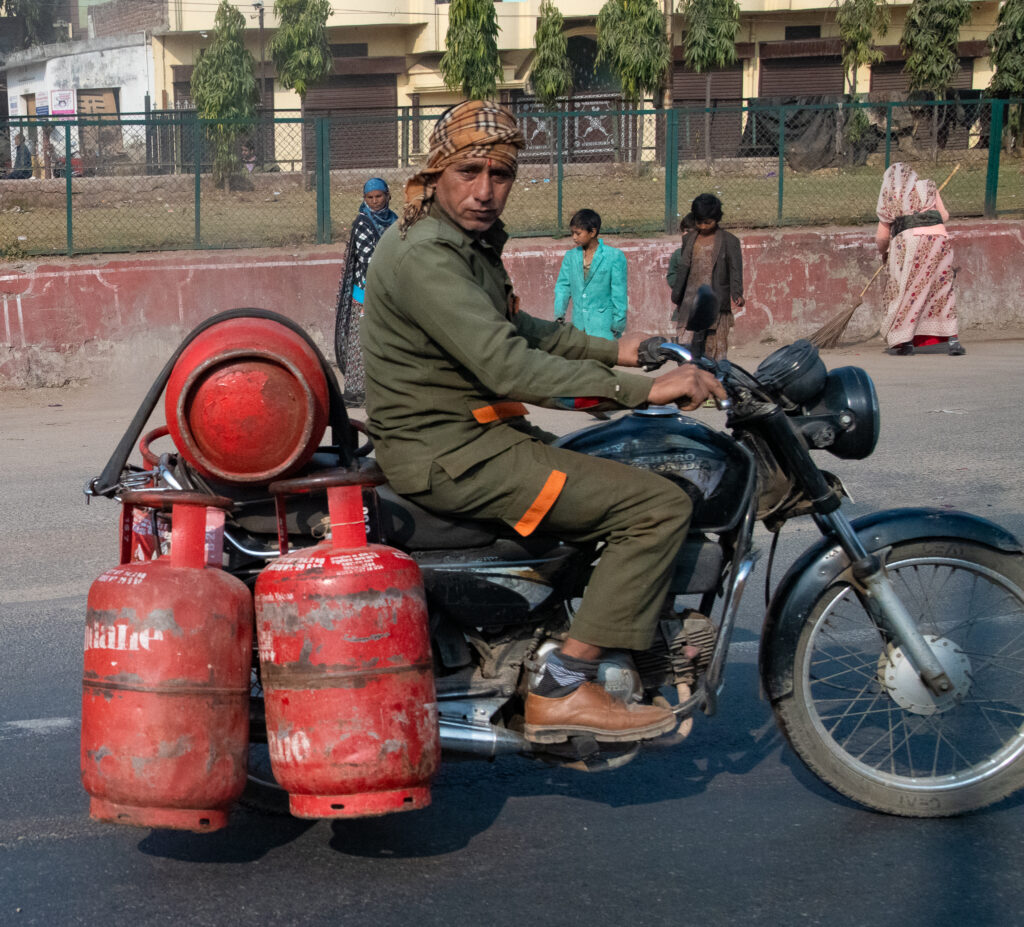
There is another feature of vehicle traffic that is simply amazing. It is what people put in and on their vehicles. Motor cycles are probably the most dramatic, from whole families somehow perched on the vehicle, wedged here or there from 4 to as many as 6 or 7 people. My pictures show a passenger holding an enormous pane of glass or an awkward metal frame, or a single driver with six large propane tanks.
The tuk tuks often contain 10 or 11 people wedged in, wound around each other. Impossibly over-loaded trucks are common.
Here is a chap hanging on to a large garbage container:
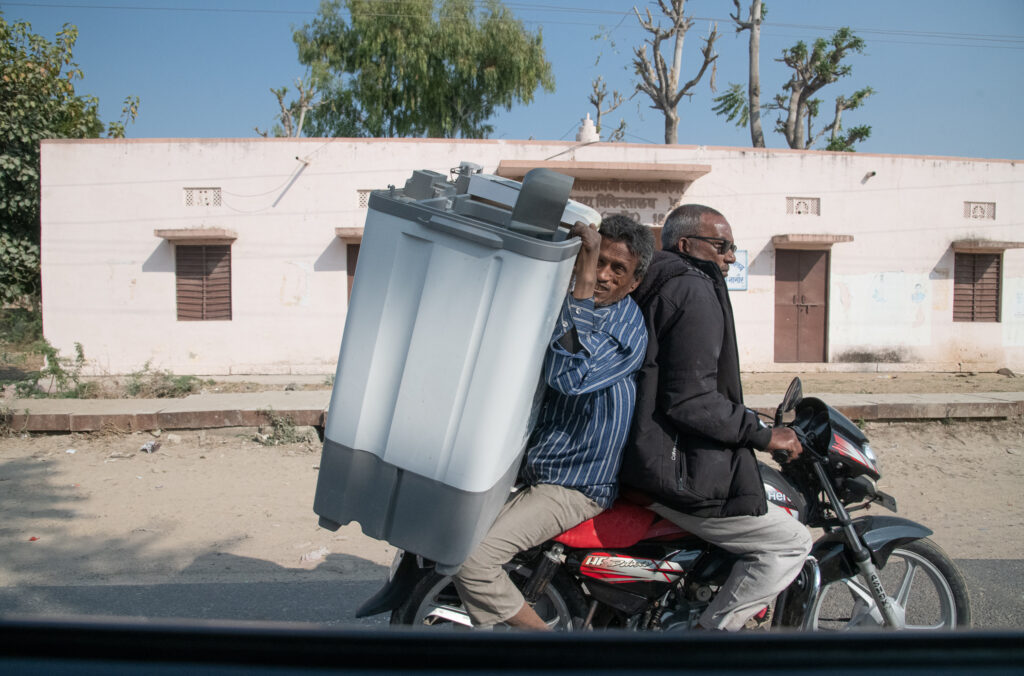
The crazy thing is that it seems to work. I saw very few accidents (although a great number of “encounter” scars). All the honking and pushing and chaos is an everyday event. What other way would you do it?
It is a strange realization that all of this chaos comes within a country that has a global reputation as the “birthplace of meditation,” with its traditions dating back thousands of years through Vedic, Hindu, and Buddhist lineages. This reached a peak in the West during the 1960s, famously catalyzed by The Beatles’ 1968 visit to Rishikesh in the Himalayas foothills to study Transcendental Meditation.
4. India/Pakistan “Beating Retreat” border “ceremonies” (Jan 27, Tuesday)
Daily a spectacle, the “Beating Retreat” flag ceremony, takes place at India’s Wagah-Attari border with Pakistan. This is near Amritsar (Punjab), India (and 18 kms from Lahore, Pakistan) and is like nothing I have ever witnessed.
To understand the quite strange and bizarre “ceremony” we witnessed some history is essential. Much of determining the borders of India didn’t come easily. In 1947, the partition of India took place which divided British India into (the Union of) India and (the Dominion of) Pakistan. The partition displaced between 12 and 20 million people along religious lines; the violent nature of the partition created an atmosphere of hostility and suspicion between India and Pakistan that plagues their relationship to the present. There is more, but the point is that they don’t like each other!
So off to the India-Pakistan border all three of us go. Our drive took 40 minutes from Amritsar, and what we found was unexpected. The daily spectacle takes place on a stretch of pavement the length of a football field, and about a third as wide, and like a sports event. There were bleachers on either side and a large double stadium at one end facing the border at the other.

Importantly, on the other side of the tall steel border barrier, in the country of Pakistan, a similar event was forming!
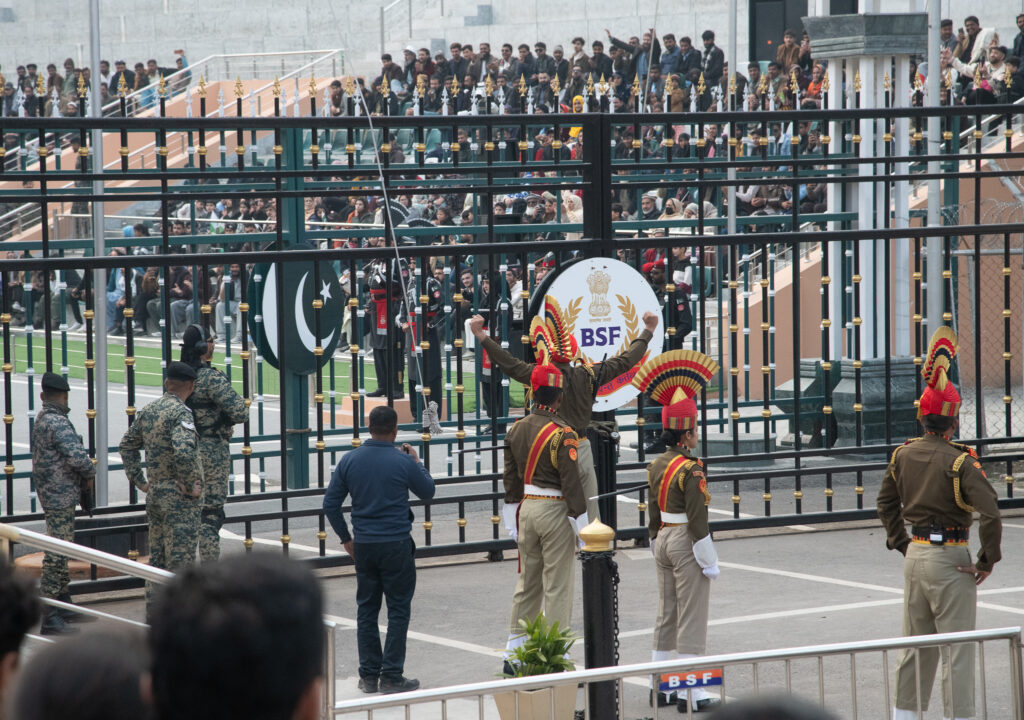
Around 4 pm, on both sides of the border, each country’s military commenced carrying out a stylized charade of threatening the other country. Seriously. The intense ritual involved soldiers from the Indian Border Security Force (BSF) where we sat, and Pakistani Rangers over the border fence.
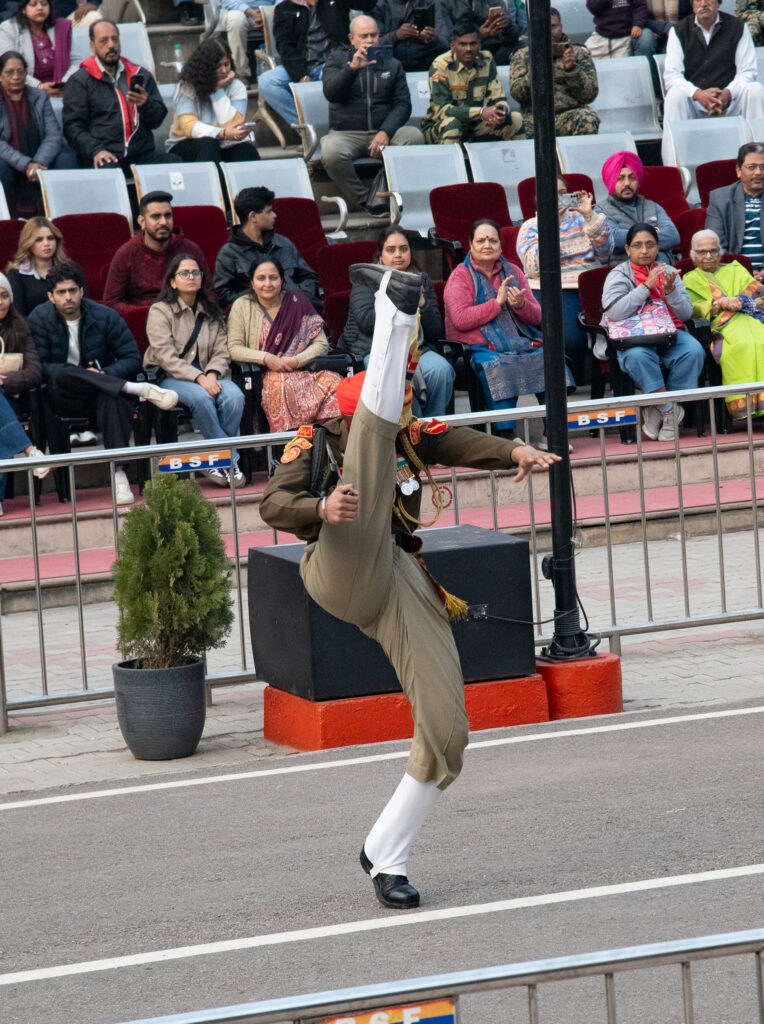
The crowd gathered was enthusiastic, and definitely partisan Indian, most with flags of India painted on their cheeks. It was both so funny and so serious. It was a high-energy, intense event featuring men performing synchronized maneuvers, high kicks, complicated heel-toe maneuvers, and national flags waving. Choreographed marching and aggressive gestures were made to the other side of the fence.
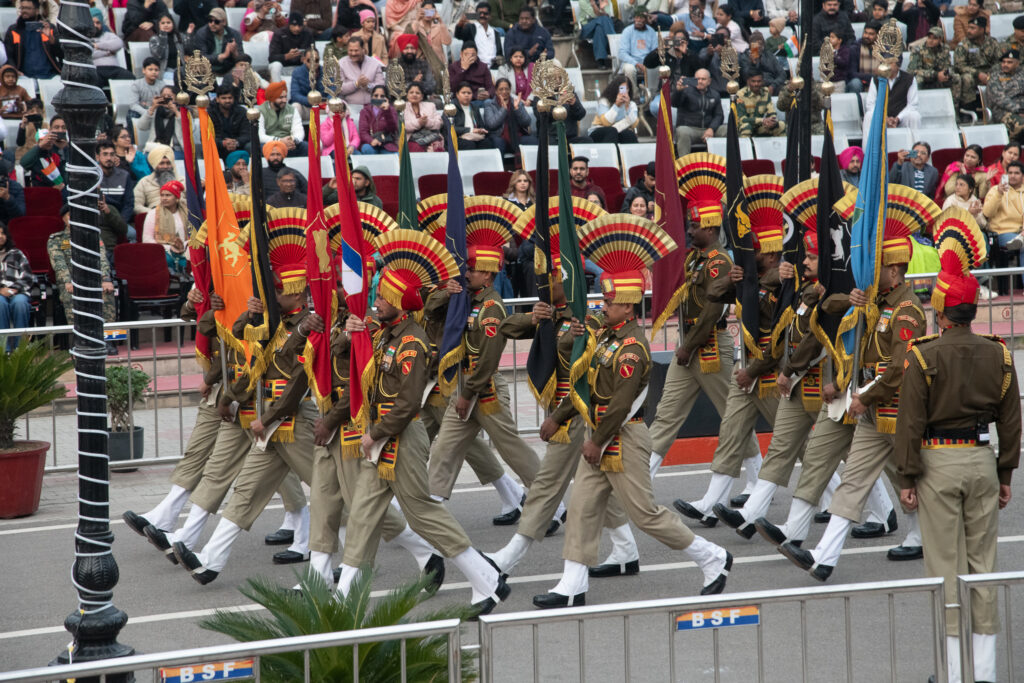
The BSF were outfitted in colourful uniforms with bird-like banners coming out of their hats. Brendan, Dylan and I all immediately had the same reaction: this was like Monty Python’s John Cleese doing his finest “silly walks”. While it was quite funny to the three of us, not so to those around us. This was a collective middle finger being given to the country they despise. To put a sobering reality to all of this, the India-Pakistan conflict, with both countries having nuclear weapons, remains one of the world’s potential flash points.

We had already known that no Indian national can travel to Pakistan; likewise no Pakistan citizens are allowed to visit India. (In my initial trip travel arrangements, I wanted to spend at the end of my India wanderings about five days in Pakistan, but I couldn’t get a direct flight. I had to go indirectly through Dubai. So I cancelled that idea.)
It all lasted for an hour, then everybody cleared out, amid the omnipresent vendors of food and goods.
5. The Taj Mahal (Jan 29, Thursday)
Considered one of the Seven Wonders of the World, the Taj Mahal really is a wonder. It was designated as a UNESCO World Heritage Site in 1983 for being “the jewel of Muslim art in India and one of the universally admired masterpieces of the world’s heritage”.
Some edifices in the world become equated with the country in which they reside. The Taj is such. It’s sort of the Brandenburg Gate, the Big Ben, the CN Tower of India. It receives global attention and attracts millions of visitors, so I did want to see it.
I was not disappointed. While it has an impossibly huge reputation, as the Mughal Emperor Shah Jahan, who commissioned it in 1631, had put his all into this structure. But its intent was simple: to create a mausoleum for the Shah’s favourite wife, the Empress of India named Mumtaz Mahal, who died that year while giving birth to their 14th child. It also houses the tomb of Shah Jahan himself. That’s right; it’s only a mausoleum and serves no real function.
The complex is located on the banks of the Yamuna River in amongst a vast Mughal garden that encompasses nearly 17 hectares, in the city of Agra, one of the most populous cities in the northern state of Uttar Pradesh.

Brendan and I travelled down to Agra by train from Delhi (Dylan had some business to attend to), a trip that took nearly 3 hours, twice its normal time due to a thick haze that hung over the journey. (This is ironic, as India has electrified 100% of its rail network in the last decade.) As a result when we finally entered the complex, it rose out of the smog. My photograph is showing it like it was, a beautiful building enveloped in “mist”.
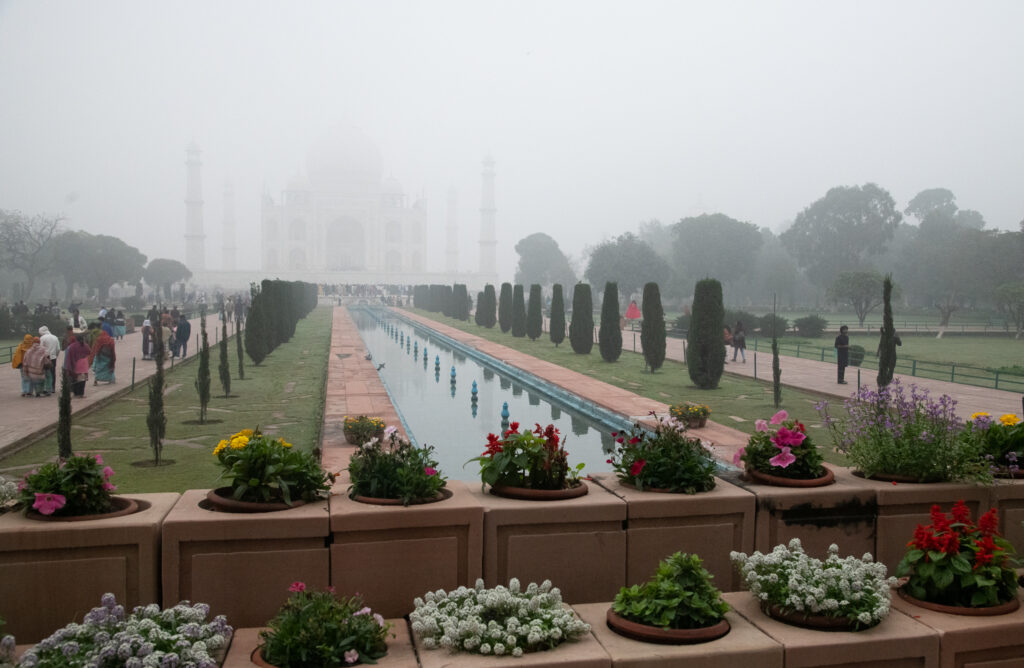
I found out later that an area of over 10,000 sq km around the Taj Mahal has been defined to protect the monument from pollution. The Supreme Court of India in 1996, delivered a ruling “banning use of coal/coke in industries located in the Taj area.” But this kind of smog doesn’t obey such edicts.
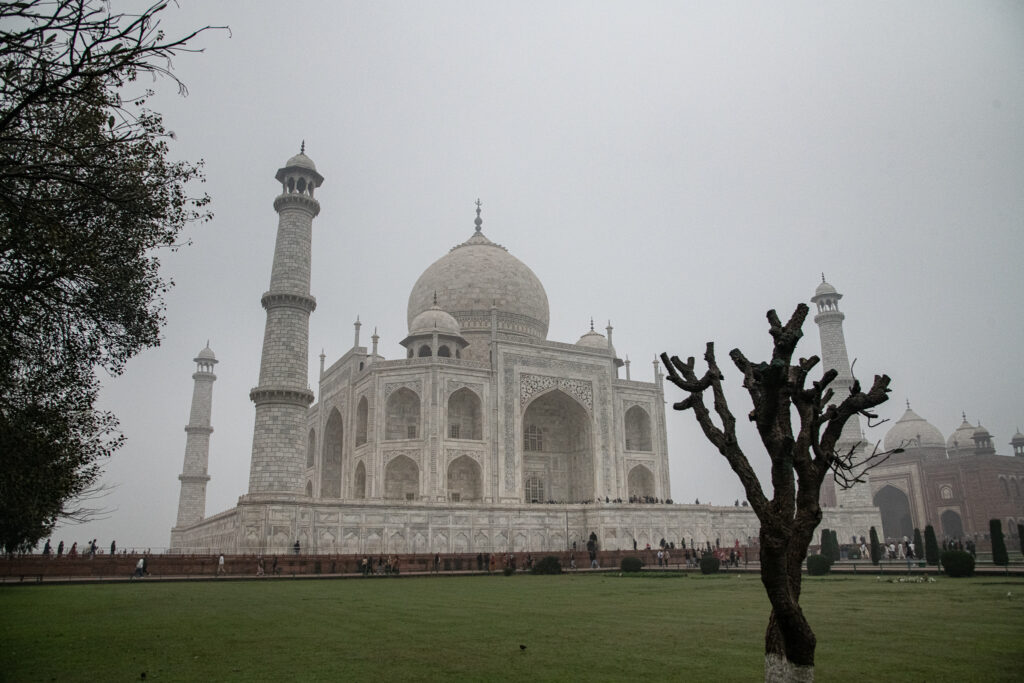
The Taj is constructed of ivory-white marble, and is an important example of Mughal architecture. The marble facade is actually translucent and appears to change hues throughout the day, apparently looking pinkish at dawn, quite white at noon, and golden at sunset, a result of the stone’s quality and light reflection.
Fine inlay work is everywhere with semi-precious stones cleverly inlaid into the marble. One interesting stone is the deep red to brown carnelian, a highly prized, natural, and untreated gemstone, traditionally sourced from the mines of Yemen; it glows when light is put on it, as was demonstrated to us by a guide. Also lapis lazuli which is renowned for its rich blue colour and golden speckles. It is mined mainly in Afghanistan and Chile.
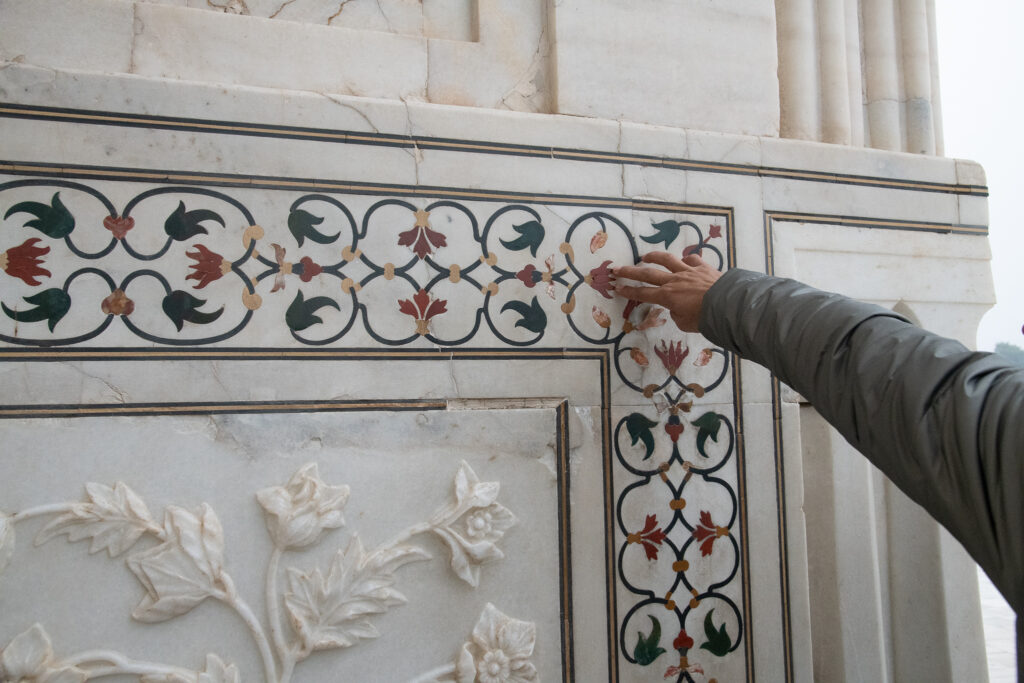
For its construction, masons, stone-cutters, inlayers, carvers, painters, calligraphers, dome builders and other artisans were requisitioned from the whole of the country and also from Central Asia and Iran. The reach was wide in building this.
The construction project employed some 20,000 artisans at a cost estimated to be around US 1 billion in 2020 dollars. The 22 small domes on the main entrance gate represented the 22 years it took to complete this mausoleum. The most spectacular feature is the 35 metre high marble dome that surmounts the tomb.
Fountains and running channels of water with large reservoirs are part of the garden design.
Its four minarets are built to tilt slightly outwards, a clever design to ensure they would fall away from the main dome and tomb in case of an earthquake. The ground plan of the Taj Mahal is in an elegant compositional balance, the octagonal tomb chamber in the centre, encompassed by the portal halls and the four corner rooms.
It may be bitchy to say this but all this grieving for his wife didn’t deter Shah Jahan from building places within the complex for two of his other wives: a domed tomb on an elevated platform near the Eastern Gate of the complex and a red sand stone edifice at the Western Gate (the main Taj entrance).
This was an interesting experience, as it was a mixture of what has been in my head over the years, with the reality of what was actually in front of me. I almost didn’t want to raise my camera to get the photo that had been buried there. This was coupled with the reality that the Taj was enveloped in a haze which, while unfortunate as to cause, did provide a certain mysteriousness.
6. Food
This had to be one of my trip themes. We went local for the whole trip, breakfast, lunch and dinner (except for one evening where we had the MaryBrown Chicken fare at the outlet that recently opened).
Each of India’s 28 states has its own culture and I was told that this is reflected in the food variety. For our geography, some of the joys for me included:
- The breads which are made minutes before you eat them, like naan and roti.
- The use of spices and herbs seem to create a certain complexity, almost layers of flavour. Spices like cardamom, cumin, turmeric, and coriander, are balanced to enhance the main ingredients.
- There are some delightful smells.
- There is a range of cooking techniques; sometimes the meal had been started the night before. This often involves complex and sometimes time-consuming preparation methods, such as marinating, slow-cooking (stews), tempering (tadka) and fermenting, which contribute to the complexity of the dishes. Some dishes are cooked for 6–8 hours or more, such as Kushka Biryani (layers of basmati rice, spiced meat or fish, vegetables, and a range of spices).
- There is a big variance, of course, as we traveled around. In Rajasthan, spicy and tangy dishes are favoured; for example, a deep-fried pastry called kachori is delicious. They usually contain lentils, beans, or vegetables and are covered in dough.
- We found authentic Punjabi food in Amritsar and Jalandhar, such as tandoori chicken, where the use of a tandoor (a clay oven) is used. They marinate chunks of chicken in a spiced yogurt before being cooked. The spices, yogurt, and heat makes this tasty.
- There are both cultural and religious distinctions. For example, as Hindus do not eat beef there are wide-ranging options for vegetarians. (India has more vegetarians than the rest of the world put together.)
- Triangular-shaped pastries called samosas, which are stuffed with boiled potatoes, lamb or ground chicken (and then deep-fried in oil), are delicious.
- I also became fond of the porridge with the cane-sugar based jaggery added to it.
- In some high-end hotels, the breakfast offering was quite extensive, with quite a selection of spices and sauces.


At the Punjab Province Restaurant in our Amritsar hotel one night we had a delightful Amritsari Thali meal which consisted of five small bowls of: Butter Chicken (tandoor roasted chicken tikka cooked in a rich tomato gravy and finished with cream and butter); Bhuna Gosht Adraki (a traditional lamb braised with onions and flavoured with mint and ginger); Aloo Wadiyan (new potatoes stir-fried with spiced lentil dumplings); Dal Amritsari (a melange of lentils tempered with coriander and cumin); and Pyazi Pulao (rice cooked on dum with caramelized onions).

Go to Attachment A ( https://powellponderings.com/india-travels-daily-journey-attachment-a/) for the very special meal we had for Brendan’s birthday in Jamavar Restaurant, Delhi on January 28. It was the apex of our India dining experience.
In the drinks department, I often would have masala chai, which is India’s national drink made with tea, sugar, milk, and spices like cardamom, cinnamon, ginger, and cloves. A yogurt-based drink, called Lassi, typically containing mangos or bananas, was excellent. There was a local Indian beer called Kingfisher, that was also pleasant. We didn’t have much wine.
Many (most?) Indians eat with their hands (after washing them thoroughly), with the use of minimal cutlery. Apparently this practice is premised on the position that eating is a sensory activity, and touch is part of the experience along with the taste, aroma of the food, and its presentation. Traditionally, the fingers are also used to feel the temperature of the food. Sometimes I used small folded portions of roti or naan flatbreads to scoop up the desired amount of say curries.
7a. Mary Brown Chicken, part 1, Gurugram (Sunday, Jan 18)
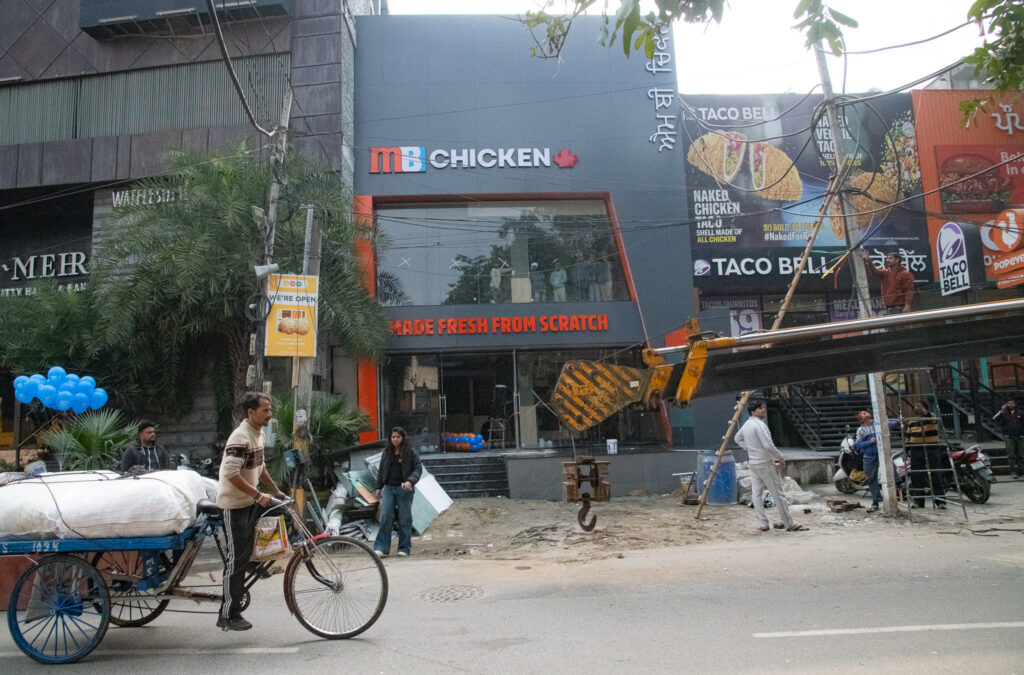
One of the first things we did in India is taste the Mary Brown Chicken offered up at their recently opened location in Gurugram about 30 km southwest of New Delhi. MB Chicken focus on fresh rather than frozen chicken (and use the slogan “Made Fresh from Scratch” reflecting the brand’s preparation methods). They plan to open a new location every month this year in India, with an initial focus on New Delhi and the Punjab State.
Dylan, as VP International for the company, is responsible for expanding the franchise around the world so far (England, Scotland, Northern Ireland, Mexico, Pakistan, US, etc.) In India, to begin the process he has chosen delightful fast-talking Anmol Mahajan as master franchisee to act on MB Chicken’s behalf for the Indian market.
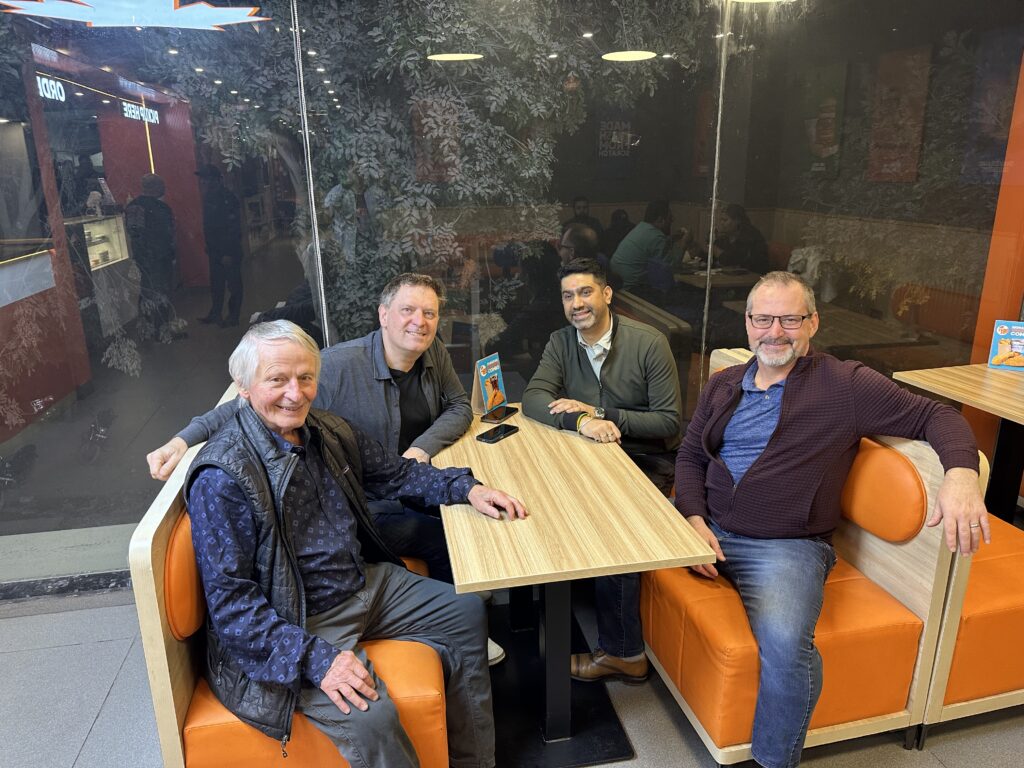
We were taken by the local manager for a full tour of the operation, including the kitchen and all of the specialized equipment on site to produce the flavours, quality and consistency they have determined is necessary. On the tour we met individually most of the staff that run, quite enthusiastically I might add, the facility. We also consumed a dinner of their chicken, and deemed it excellent (that’s a customer speaking, not a father!)
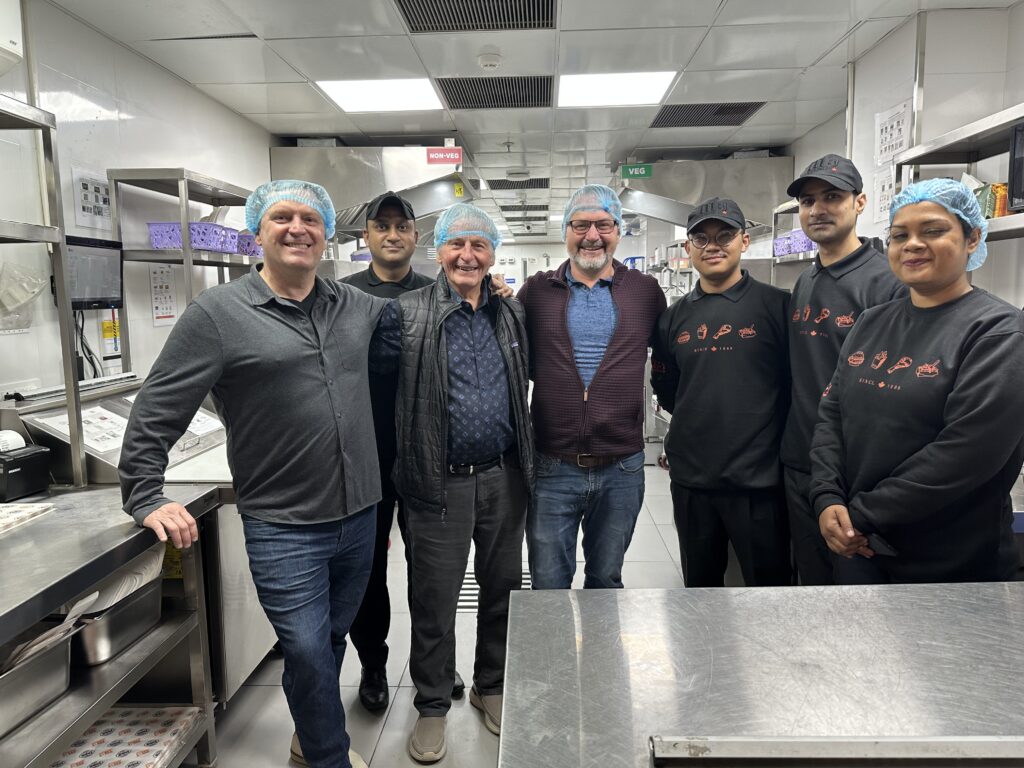
This was terrific, as Brendan and I received an understanding of one side of what Dylan does.
16 days later, I was a co-cutter of the ribbon that opened the first MB Chicken outlet in the city of Jalandhar. See next.
7b. Mary Brown Chicken, part 2, Jalandhar (Sunday, February 1)
Brendan and I participated in the opening of the first MB Chicken outlet in this city. As I said, I was chosen (age had a lot to do with it) to co-cut the ribbon. All was captured in photos and on video, and off it went to the wonderful marketing world of social media.
It was fun to meet all of the management and their friends and relatives, and other important people around that were involved in licensing and building the site up. While not everything was in full operation, it was enough to launch the ship.
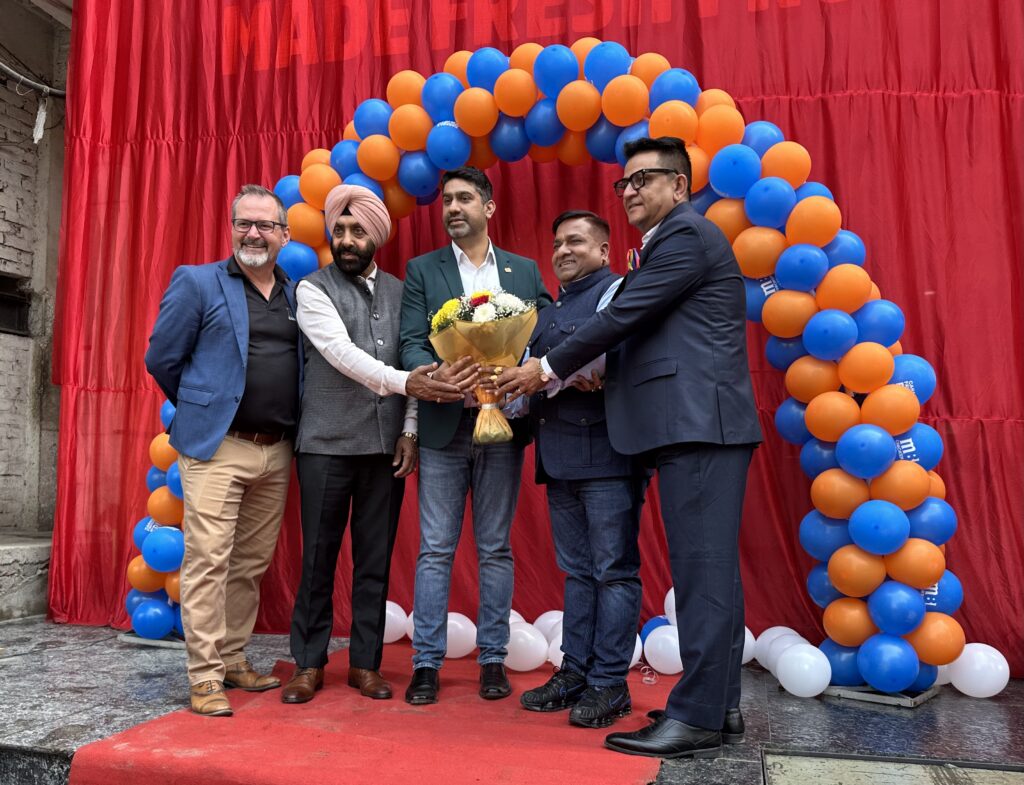
The present owner, Newfoundland entrepreneur Greg Roberts who bought this company in 2007, or even those who started it in St. John’s way back in 1969, all should have good Newfie grins on their faces.
So here is a photo of the outlet, beside its Taco Bell neighbour, in the final stages of being finished.
Wrap up
While I knew India would be a land of contrasts, my journey presented a country with more uneven issues than expected. The joys are there – the people, the food, the history; the difficulties are there as well, particularly as order and symmetry transmute to chaos and sensory overload.
Regarding the people, my take away from all of the interactions I had was certainly positive. Not one person didn’t speak and act both courteously and respectfully, from the drivers we had, to hotel and restaurant personnel, and to the business contacts. There seems to be a real respect for children through to elders. In fact respect seems to be a cornerstone of social conduct in general.
Do the populous appear guided by spiritual dimensions? The reading I have done says yes. The fact is that India is the birthplace of four major world religions. Daily lives seem to be rooted in spiritual concepts, such as dharma or duty, and karma, where a good number believe that people will reap the benefits of their good deeds and pay the price for their bad deeds, often in a future life.
This “as you sow, so shall you reap” approach may be used to explain the inequalities in life you see everywhere, whether they be wealth, poverty, health, and social status.
Regarding the food, I obtained a feeling of civilized sensitivity both in how and what is prepared, but how it is eaten. Many elements come together: the ancient selection of ingredients including spices and preparation techniques; the eating with the right hand; a high orientation to colour; the various levels of taste, heat and cold; and the role presentation and smell plays.
Regarding the history, you sense that their complex history, going back over 4,000 years and being one of the world’s oldest continuous civilizations, is important to them. I received some of this from visiting the old forts and palaces of the maharajas and other historical characters and the various other, mostly male, that populate their past.
That old colonial past creeps in everywhere, including such things as the railway, the English language, a parliamentary form of government, the civil service, the judicial system, the press, an overall unified Indian state.
But it’s all so uneven. The scars are there. The poverty below a certain level in society is grinding and desperate, although they have made significant moves. But it’s the extremes, from poverty to wealth, from ugly to beauty (or even intensity wrapped in beauty) that are startling.
While some of the edifices are magnificent, they are those that are not. The cities have a certain basic ugliness to them, with dirt, and unpainted buildings, and the garbage and detritus surrounding it all. Visually, the smog doesn’t help.

The pollution levels should now be unacceptable. That the air is this bad really does take me back to what I read about the days before the great London fire in 1666 when people died and everyone knew why they died – because of the use of coal made the air very polluted. Counties around the world are grasping this but India doesn’t seem to be able to.
The whole, in my terms, crazy, sacred cow thing is just that – crazy. To have them wander the streets and highways, causing traffic problems for sure, and the dirt and crap that all goes with it is to me habits that civilized societies purged back century’s ago. And the inability to manage the dog population has no real religious or any other excuse. Noise is winning on the noise/peace scale.
Finally, there is this absurd overriding nature of the back and forth with their neighbour, Pakistan, exemplified by the border ceremonies. The hasty Partition of 1947 created the enduring dispute over Jammu and Kashmi, has resulted in the danger of two nuclear countries duelling it out.
So in summary, the casual visitor will encounter many competing tensions within the Indian society that will constantly test ones values.
Amazing derailed account, written and photographed by a man who is anything other than a casual visitor.
Congratulations, Ken, on another splendid travelogue. I was especially impressed with the customized map you made of your route. I have always wanted to travel to India but your emphasis on the massive pollution is giving me second thoughts. It was also delightful to know you shared everything with your sons.
Wonderful blog Ken
reminds me of how ambivalent Shannon was about her visit
I would love to eavesdrop on the two of you discussing impressions of India
Wonderful blog…. Love that spectacle at the Amritsar border…..missed out on that in 1969 when it was a dusty seedy military border checkpoint
Great thing to do with your boys
Keep it coming
David
Having just an hour ago finished reading for the second time, Rohinton Mistry’s Such a Long Journey, which is an examination of a middle class Indian clerk’s life, your synopsis of India affirmed all the observations of the novel. What an amazing trip you have had! I too would love to experience it but lack your courage.
Thanks so much for sharing. (Written from Bucerias, MX)