Day by Day Journey and Activities
1. Delhi: Brendan and I flew in to Delhi from our three day stopover in Dubai. In and out of Delhi several times, so dealt with in the main blog.
2. City of Gurugram, Mary Brown Chicken, part 1 (Sunday, Jan 18)
One of the first things we did in India is visit the recently opened Mary Brown Chicken in Gurugram near New Delhi. This was covered in my main blog.
3. Chokhi Dhani Village, Jaipur (Monday, Jan 19, pm)
Jaipur was the next city we drove to after arriving in Delhi (after our visit to the Mary Brown outlet in Gurugram). The drive took took us four hours from Delhi. Jaipur is the capital and largest city (over 4.5 million) of the north-western Indian state of Rajasthan. It is part of the Western Golden Triangle tourist circuit along with Delhi and Agra.
The first evening there we went to the Chokhi Dhani Village. This is modelled as a traditional, rural Rajasthani village with huts and folk art, giving you an authentic Rajasthani cultural experience. It was sort of a miniature version of Disney World, but while fun, much kitschier.
It presented folk performances, puppet shows, camel, elephant, and horse rides, and rustic, mud-walled, lamp-lit surroundings.
The best part was the dinner, an authentic Rajasthani thali which is a round platter containing many different dishes. On each thali, we found several katoris (small round bowls) filled with raitas, lentils, vegetables, pickles, and chutneys. It was served with flatbread, and a refreshing drink called sol kadi, made with coconut milk.

Here we are with our thali. Apparently the platter represents the Ayurvedic concept of six tastes: Madhura (sweet), Amla (salt), Lavana (sour), Katu (pungent), Kashaya (astringent), and Tikta (bitter).
All during the meal one man was playing on a harmonium (a hand-pumped reed organ) and another on two drums, all dinner long and often quite loudly. Did I say all dinner long?

4. Amber Fort, Jaipur (Tuesday, Jan 20)
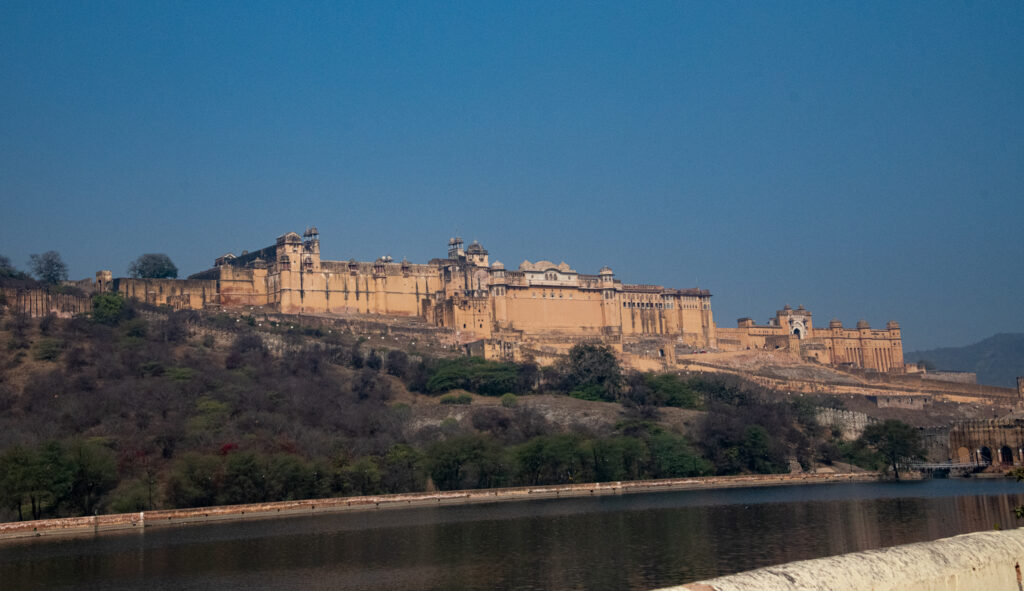
The next day we drove about 10 km out to the Amber Fort (also called Palace). It’s located high on a hill, with large ramparts and series of gates and cobbled paths, and overlooks the Maota Lake.
The palace was the residence of the Rajput Maharajas and their families. It was completed in 1599 during the reign of Raja Man Singh. He had 12 queens so he made 12 rooms, one for each Queen. Each room had a staircase conveniently connected to the King’s room.
We drove down to a palace in the middle of a lake, the Jal Mahal, also known as the Water Palace. It is built in Rajput style architecture, and is a 17th-century architectural beauty.
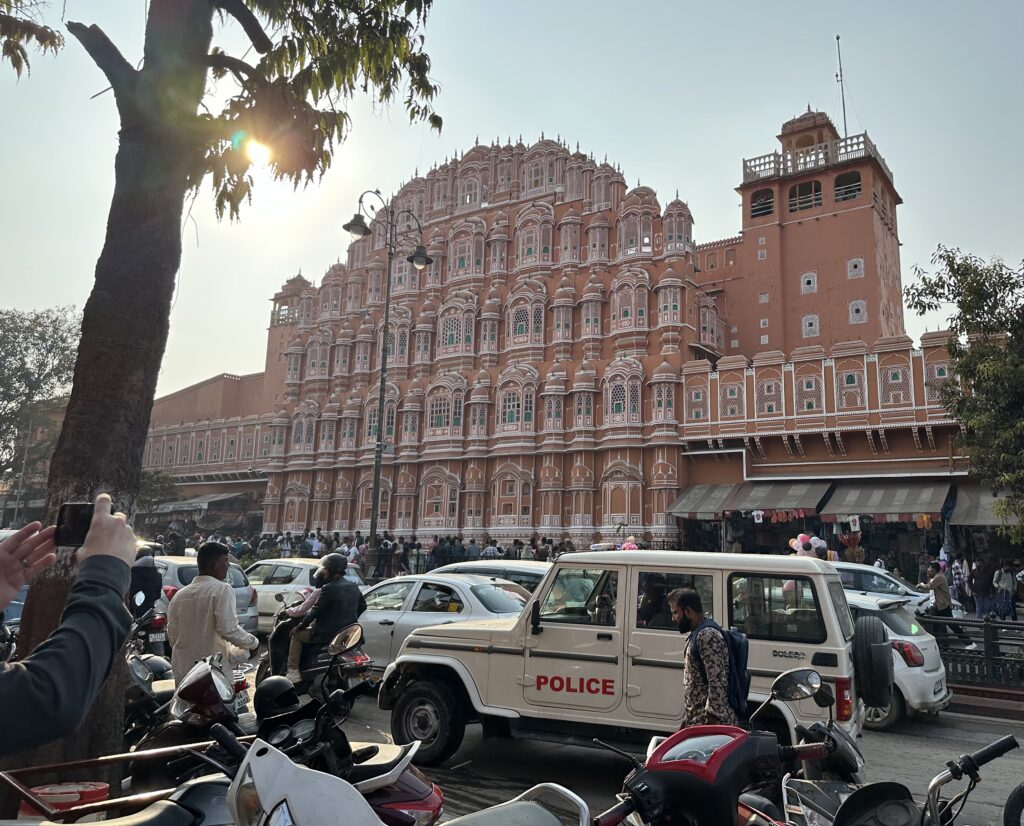
Then to Hawa Mahal, also known as the “palace of winds”, built in 1799. It is considered unique as it has many small windows and balconies that seem like a honeycomb.
5. Pushkar Lake (Wednesday, Jan 21)
Our driver picked us up at our hotel in Jaipur, the Rajasthan Palace Hotel and we headed off to Jodhpur, a six hour drive. On the way, Brendan turned on Mark Carney’s Davos speech, after which our conversation solved all the problems of the world. (We have done this a number of times.)
About half way along we stopped in Pushkar. This is an ancient temple town located on the shore of Pushkar Lake in the state of Rajasthan. The city is noted for its mythological associations, temples, and heritage architecture. It is home to one of the few temples dedicated to Brahma. A pilgrimage to Pushkar is considered highly meritorious within Hinduism.
Pushkar is believed to be the place where Brahma performed penance for a very long time. It is believed that Lord Brahma vanquished a demon, Vajranash, using a lotus flower. The lotus flower fell to the ground, and created Pushkar Lake. Devout followers attempt to visit at least once in their lifetime. It is believed that no pilgrimage is complete without bathing in its sacred waters.
Temples for all four of India’s major religions exist in this city. So it’s likely a good place for reflecting on the differences. While we all concur on our own philosophical approach to life, we didn’t let that opportunity pass and an extended, quite lively conversation on religion resulted.
At first the city was interesting. There was a constant sound of chanting, drumming and incense-fuelled puja (making offerings). Brendan got into a long conversation down by the water (see him) with a devotee, who gave (i.e. sold) him flowers to throw into the lake.
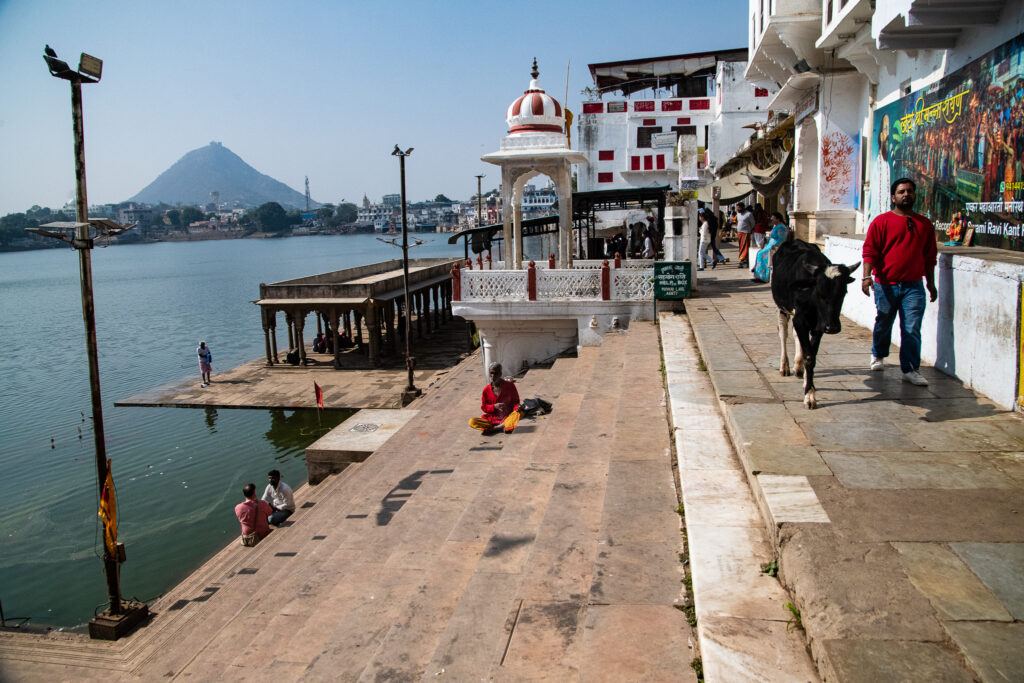
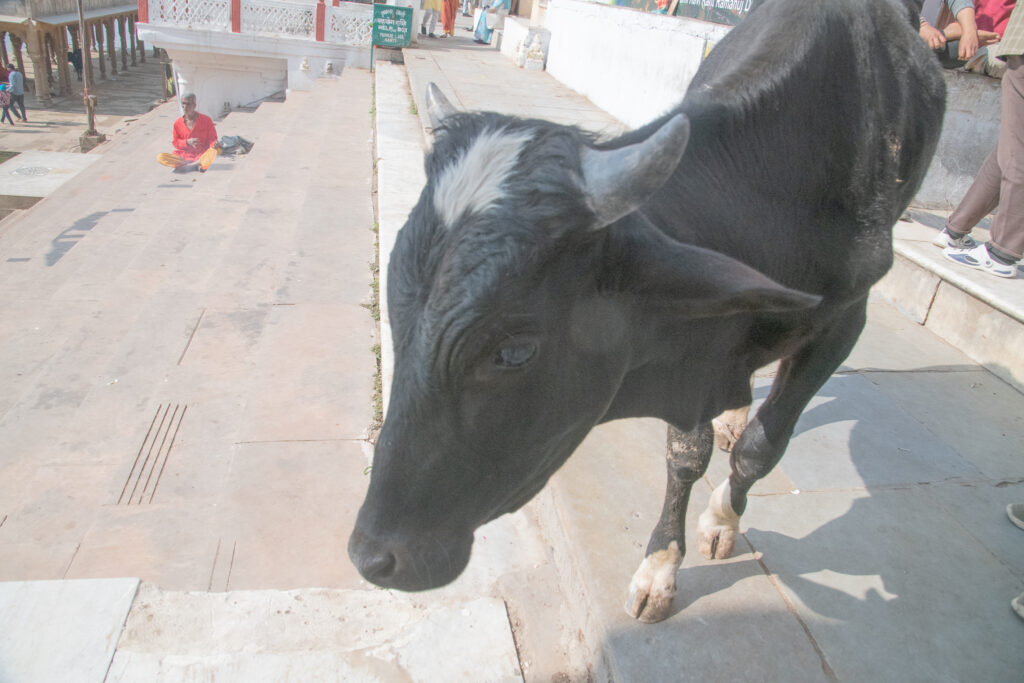
Dylan and I were accosted by another intense believer, and he really wanted to have us listen to him about the fact that Hindus consider a journey to Pushkar to be the ultimate pilgrimage that must be undertaken to attain salvation. I have a video of Dylan talking to him about “the holy water coming from the ground”, all the while a large, black cow is edging its massive way by me.
But the town is heavily touristic, with one long bazaar stretching the entire length of the lake, selling trinkets, low-quality souvenirs, and elephant print trousers. That and the over zealous ideologue hassling us made us feel we wanted to get out of there.
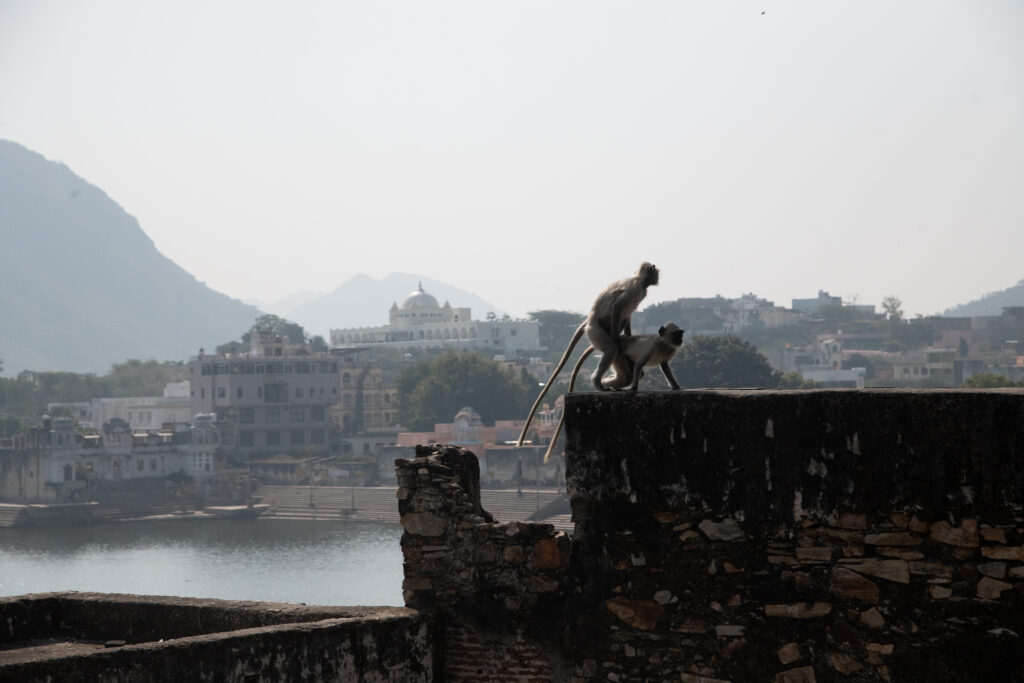
One amusing incident I duly captured with my long lens was two langurs (slender, long-tailed Old World monkeys) who ran across a retaining wall and in a mid-stage performance, with a domed temple in the background, screwed quite enthusiastically and then ran off. Take that, you temples.
Once in Jodhpur, the evening meal on the top of our hotel, the Kankariya Heritage, presented a stunning sunset dipping below the edge of the Mehrangarh Fort, where we would tour tomorrow afternoon. As we ate dinner we listened to four musicians play and sing. They were terrific and enthusiastic. One worked hard on a harmonium that sat on the floor, and one played a small yow-headed drum called a dholak; another chap played hand-held castanets.

An amusing sight were the dogs lying on top of the parked cars, sort of sunning themselves.
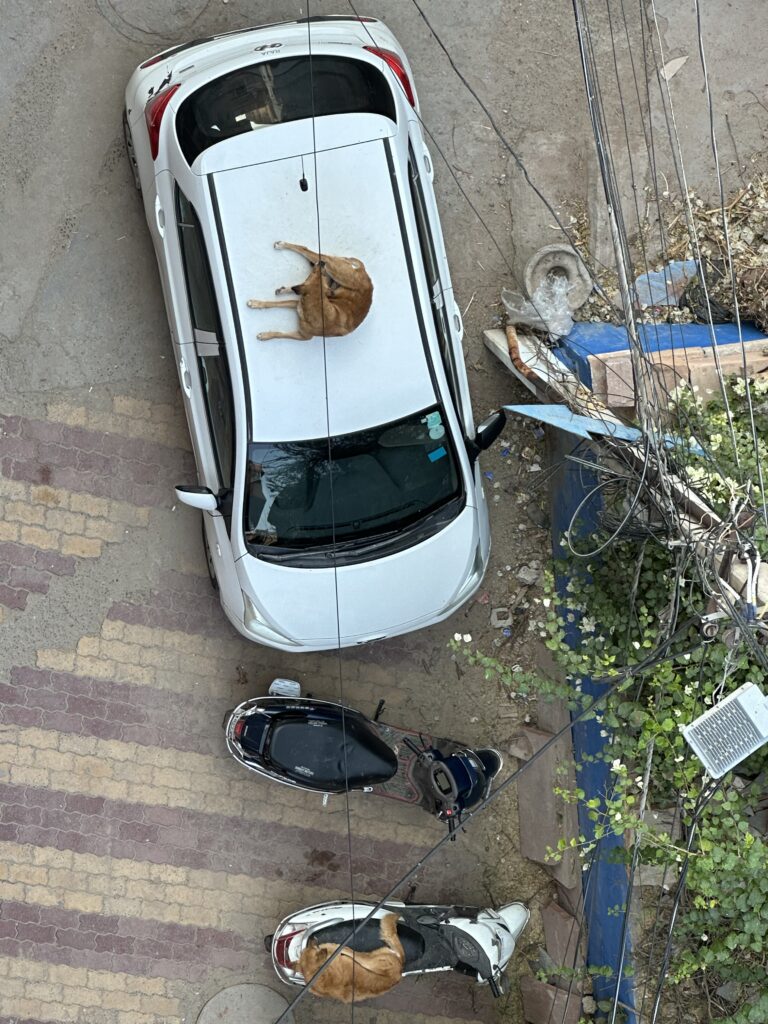
Some cars had spiked covers to prevent this, so this is not a rare random dog habit.
6. The Jaswant Thada cenotaph, Jodhpur (Thursday, Jan 22, am)
In the morning, our driver took us to Jaswant Thada, a 19th-century white marble cenotaph. It was built in 1899 by Maharaja Sardar Singh to honour his father. It serves as the traditional cremation ground for the Marwar royal family. It is known as the “Taj Mahal of Marwar” because its thin, polished marble sheets emit a warm, golden glow in the sunlight, similar to the Taj Mahal.
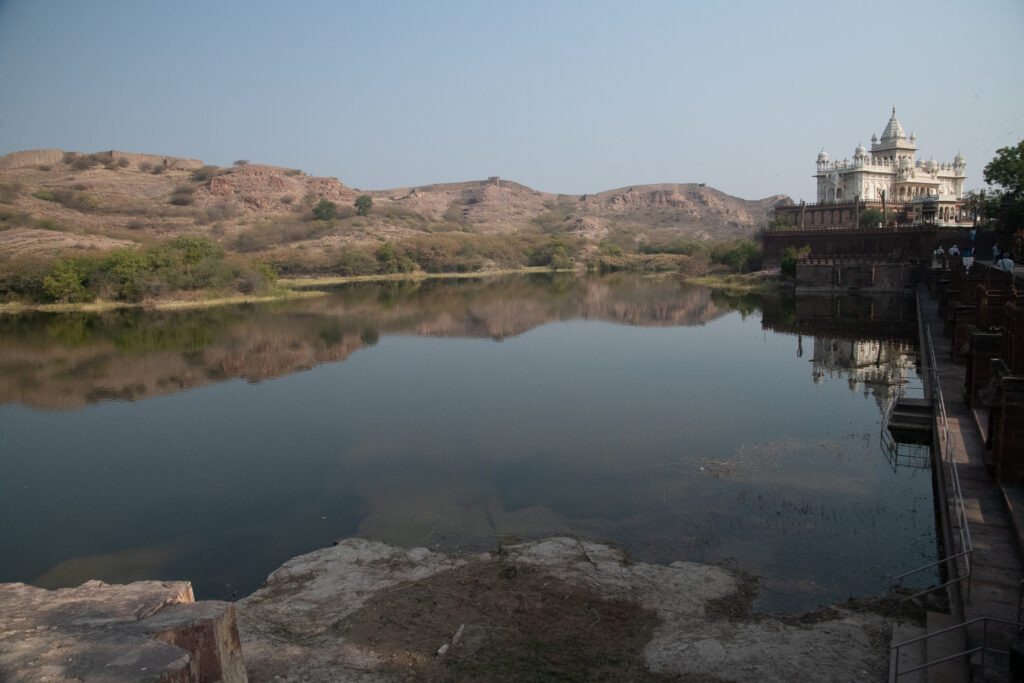
Apparently it’s a key example of Rajputana architecture, an amalgam of Mughal and Hindu structural design. The pure white marble of the cenotaph is contrasted with red marble on the steps leading up to the monument, which gives the entire monument quite a vibrant appeal. The craftsmanship is from a bygone era in Rajasthan, and a big tourist attraction.
The cenotaph is famous for its intricately carved marble sheets which are extremely thin and polished in such a manner that they emit a warm glow when illuminated by the suns’ rays. Our guide cleverly demonstrated this by having the lights turned off; light appeared to come through the marble!
Hanging on the wall were some great portraits of past rulers of the princely state of Jodhpur. There were some mighty moustaches!

There is a reddish brown rocky approach to Jaswant Thada that dominates the landscape and gives it sort of a mystical aura.
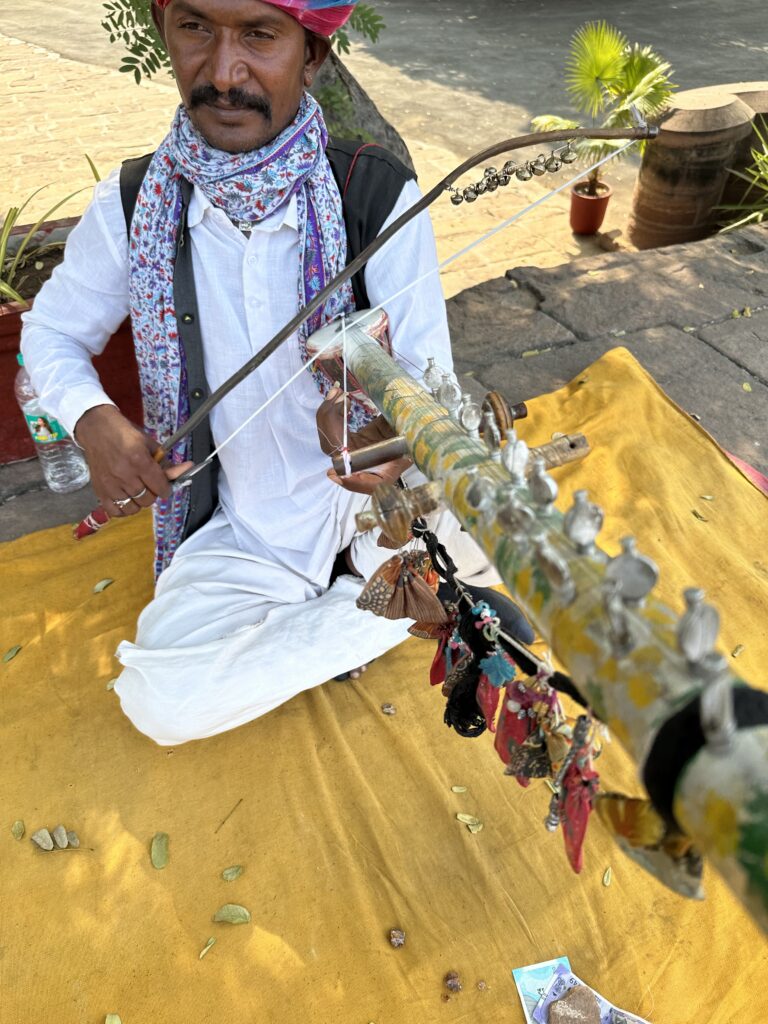
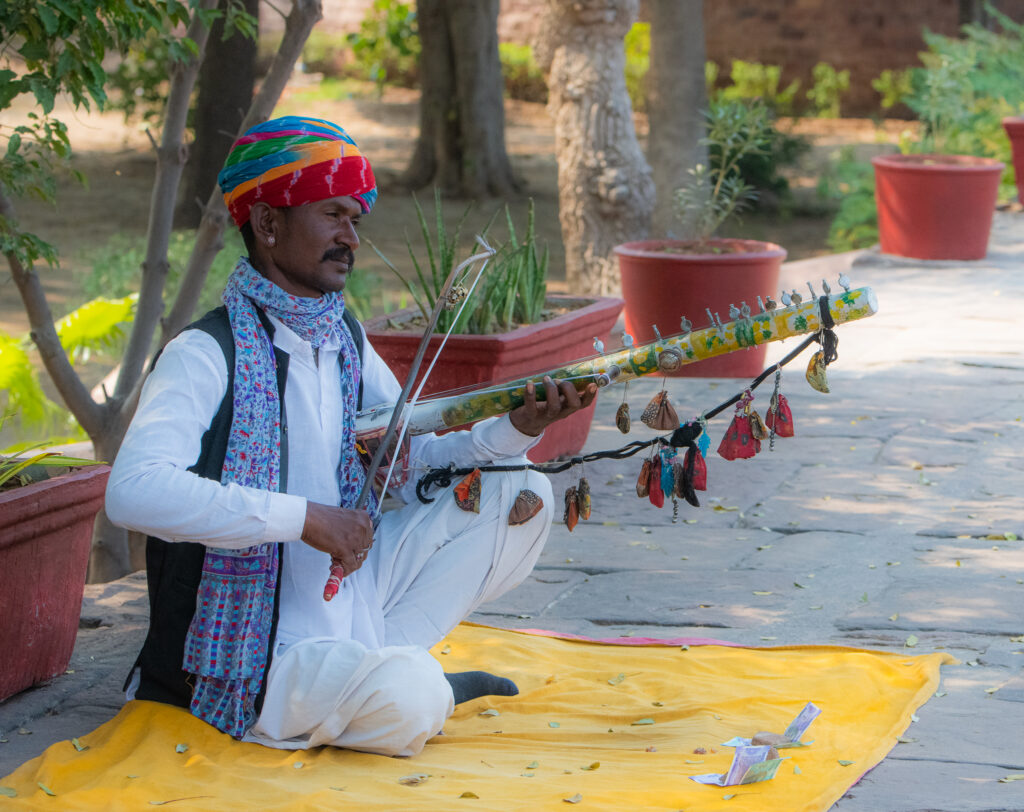
On the way we passed a man playing a single stringed instrument called a ravanhattha, an ancient bowed, stringed device originating in India. It is widely considered one of the oldest stringed musical instruments in the world and is often cited as a likely ancestor of the violin. The man was playing with a curved bow, with small bells attached, drawing it across the strings.
7. Mehrangarh Fort, Jodhpur, Rajasthan (Thursday, Jan 22, pm)
This 15th-century hilltop citadel was founded in 1459. Towering 400 feet over the “Blue City,” it is one of India’s largest forts. Jodhpur is called the “Blue City” because a significant number of homes in its old city, particularly around the Mehrangarh Fort, are painted shades of blue.

The fort contains decorated palaces, including the Moti Mahal (Pearl Palace), Phool Mahal (Flower Palace), and Sheesh Mahal (Hall of Mirrors). It is encased in massive, 36-meter-high walls. It also has an excellent museum with a collection of weapons, paintings, and royal palanquins (ornate litters used historically to transport monarchs and other important people).
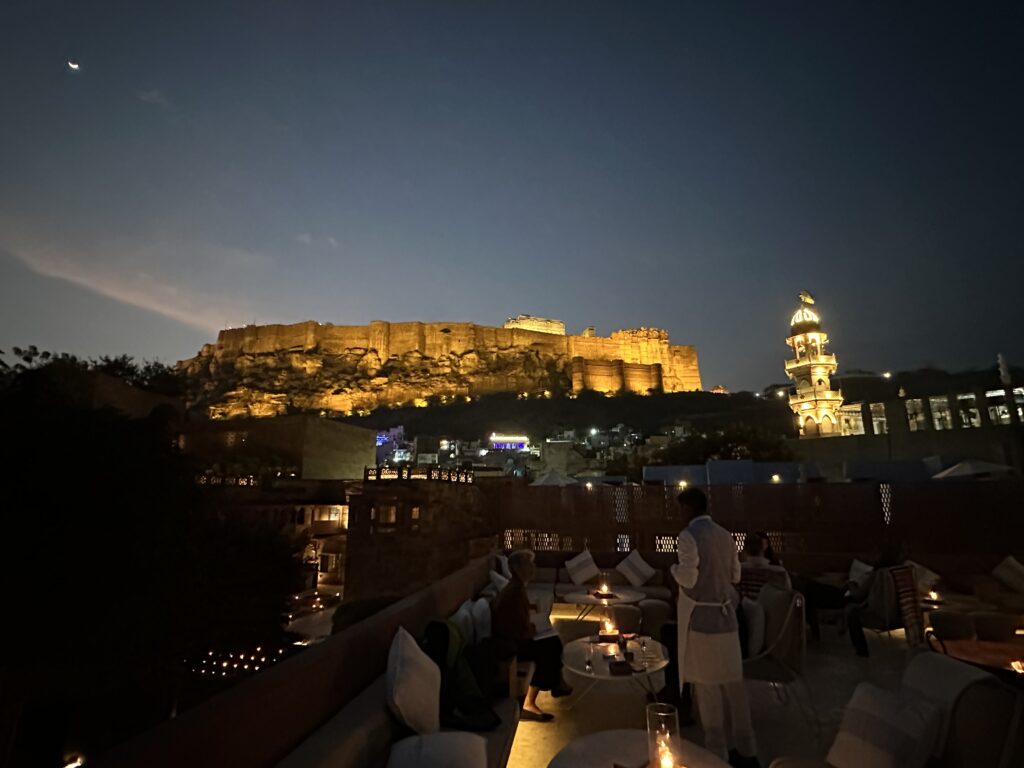
That night we went to a high end dining spot in the Walled City Hotel. It was on an open roof again looking at the Mehrangarh Fort hovering in the distance. While we ordered drinks we listened to, and rated, the sunset “call to prayer”. This muezzin was rated 6.5 out of 10 on the Powell adhan prayer rating system. He should have been better, for he does do it five times a day. Delicious meal: I had tandoori lobster, and an excellent Killibinbin Chardonnay.
8. Travel to Jaisalmer; Bhang Shop; Gadisar Lake (Friday, Jan 23)
We had a long 5 hour drive from Jodhpur to Jaisalmer, Rajasthan, and checked into our hotel, called Royal Villa. A “quaint” small room into which we brought a cot leaving little floor space, except for the large window ledges we could sit on. Whatever.
The city is known as the “Golden City” because of the yellow sandstone buildings that sort of glow in the sunset.
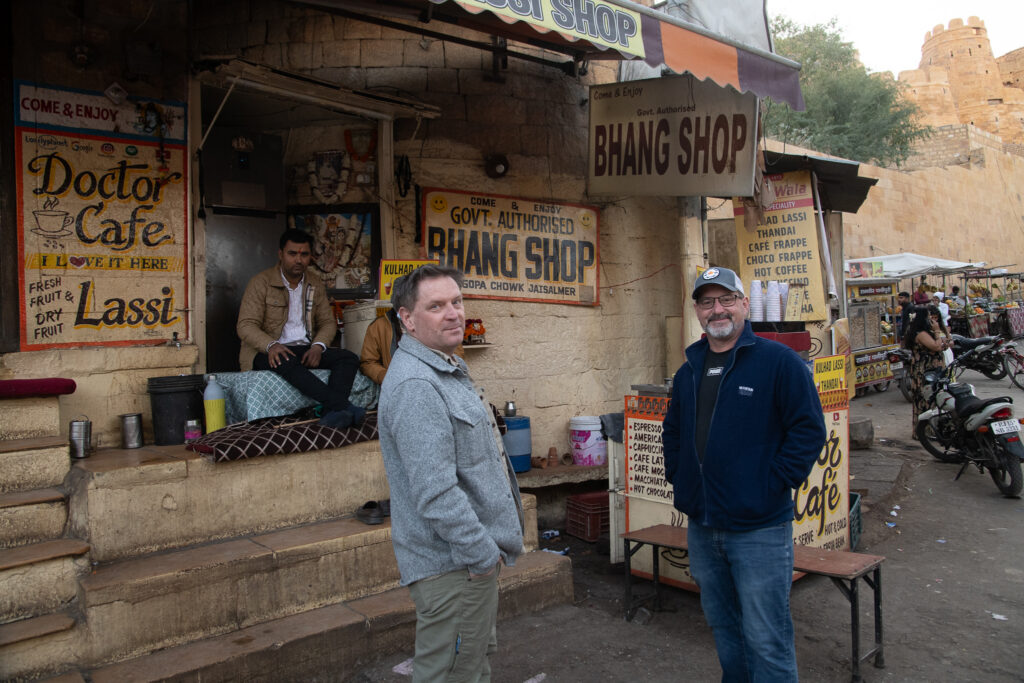
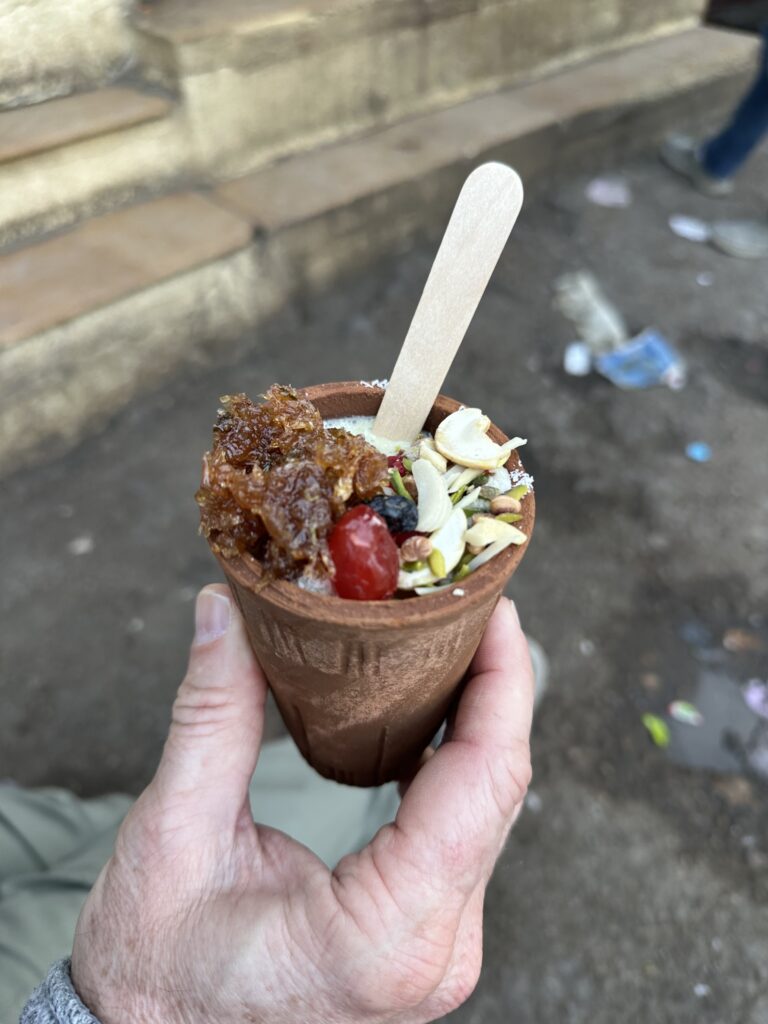
Out for a walk we stopped at the infamous “government authorized” Bhang Shop (it is one of the few Government authorized cannabis or Bhang shops in India). This meant that the lassis (local yoghurt drinks) include edible cannabis in the mix. (They also have drug-laced cookies and joints, if drug-laced drinks aren’t your thing.) Brendan and Dylan being Brendan and Dylan ordered; I sipped on mine eyeing the cannabis leaves and buds floating around my cup.
Apparently the Bhang Shop has been serving up traditional bhang beverages since the 1970s. For those that care, Anthony Bourdain also had a Bhang lassi from the same shop on season 2 of No Reservations.
An encounter with some local students around 20 to 23 years old provided a laugh. They learned I was 86, and one of them said “impossible” with a big laugh. I have a video of this.

We took a tuk tuk (auto-rickshaw) all around the downtown area, and were dropped off at a restaurant we had chosen looking out over an artificial lake, Gadisar Lake (near Jaisalmer Fort). The lake was built with the purpose of storing water as the region suffers from a serious water shortage.
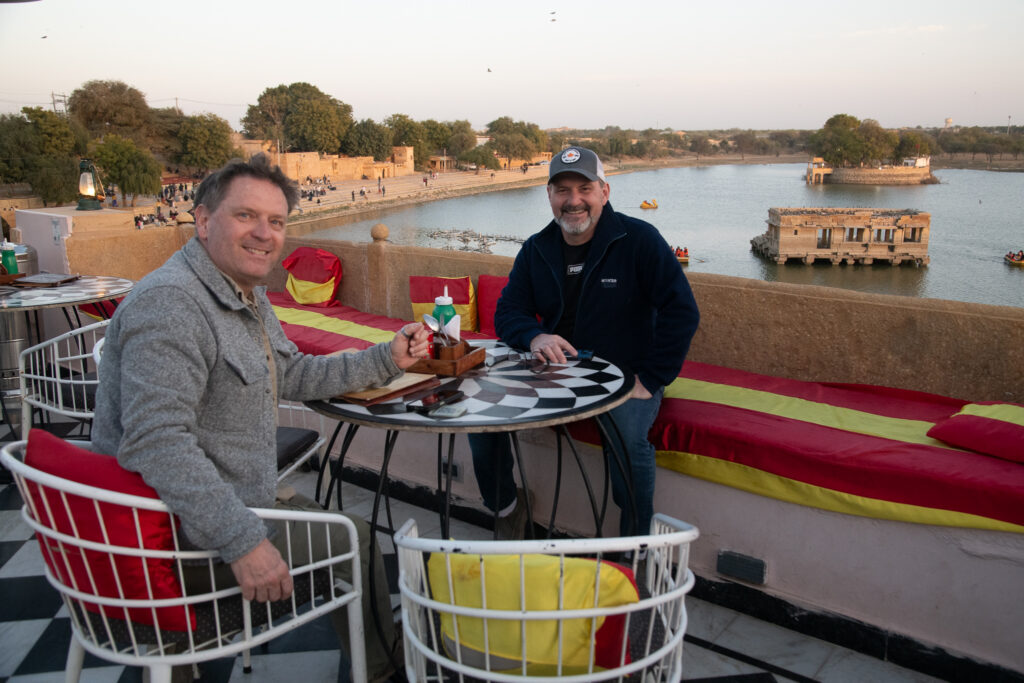
There are many temples adjoining the lake, including those of Lord Shiva and Lord Krishna, which makes it ideal for pilgrims.
9. Jaisalmer Fort, etc, Jaisalmer, Rajasthan (Saturday, Jan 24)
Within the Jaisalmer Fort complex, there is a cluster of Jain temples that includes both a Chandraprabha temple and a Parsvanath temple. The latter is the oldest and most beautiful; it was built in 1416. We visited both.
We then visited the Mandir Palace, a 200-year-old historic heritage property known for its exquisite stone carving, intricate balconies, and canopies. Built for the Jaisalmer royal family, it features a unique pagoda-like Tazia Tower.
Also toured around the Kothari’s Patwa Haveli museum which displays living quarters and elaborate rooms with walls adorned with murals and mirror work. Musical instruments such as a Sitar, board games, a chessboard and other artefacts from the 19th century are displayed in the main sitting room area of the haveli.
We wandered through the market after. Lots of local colour.
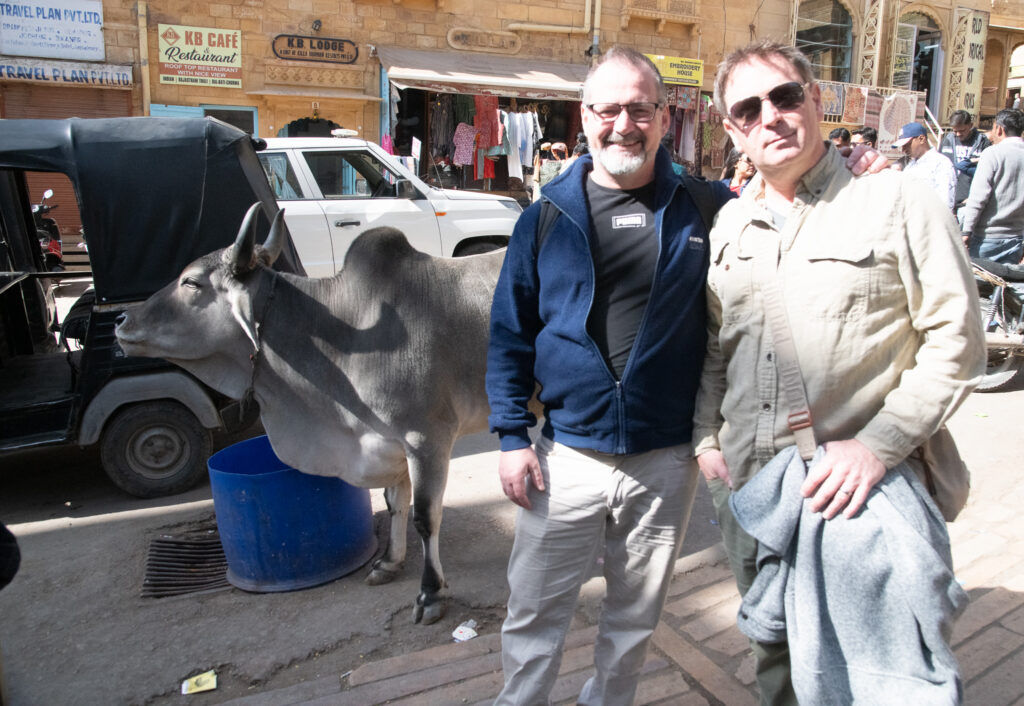
Saw two amusing signs, one outside a clothing shop “Come on in; it will give me a chance to rip you off.” And another beside a rack of T shirts said “Hand made”.
10. Desert experience, with camels, near Jaisalmer (Saturday, Jan 24, pm)
In the late afternoon, we were driven out to the Royal Empire Camp Resort. The word “resort” doesn’t quite cut it, as we were shown our tent, but so be it; we had signed up for it.

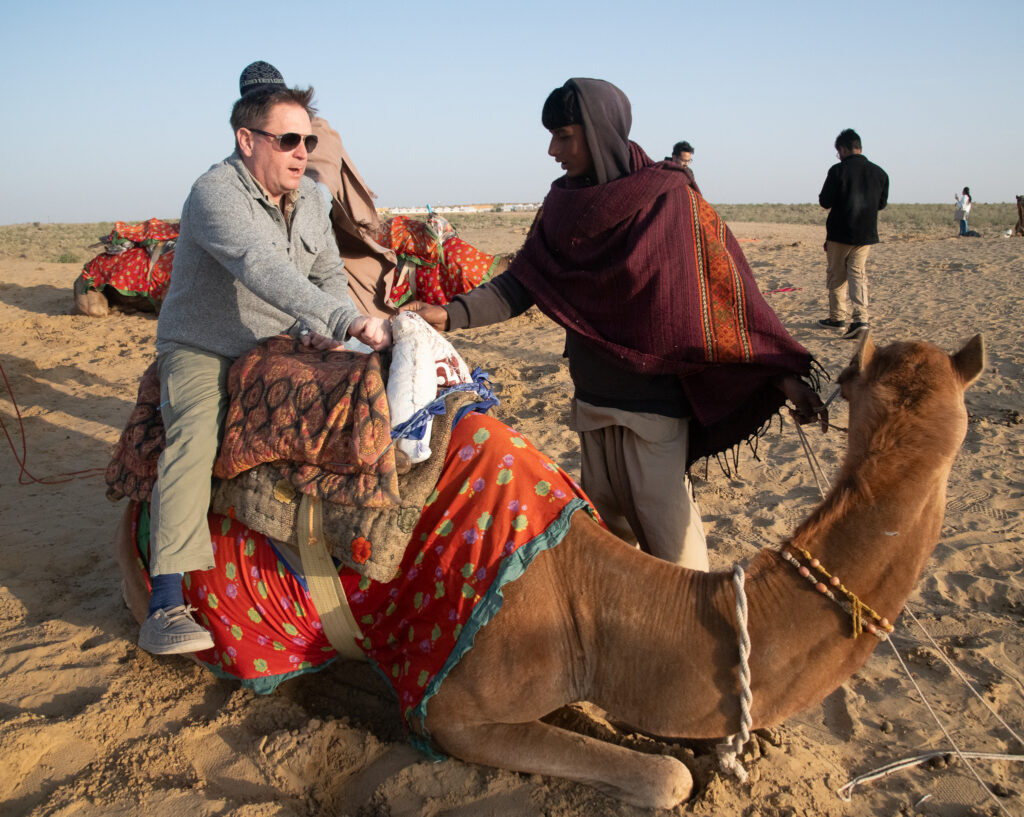
This was somewhat similar to what Brendan and I did in Dubai, but the camels seemed harder, ornerier and more stubborn looking. So, yes, I did it again and climbed on one, and rode off into the sunset as it was evening and it was getting cooler.
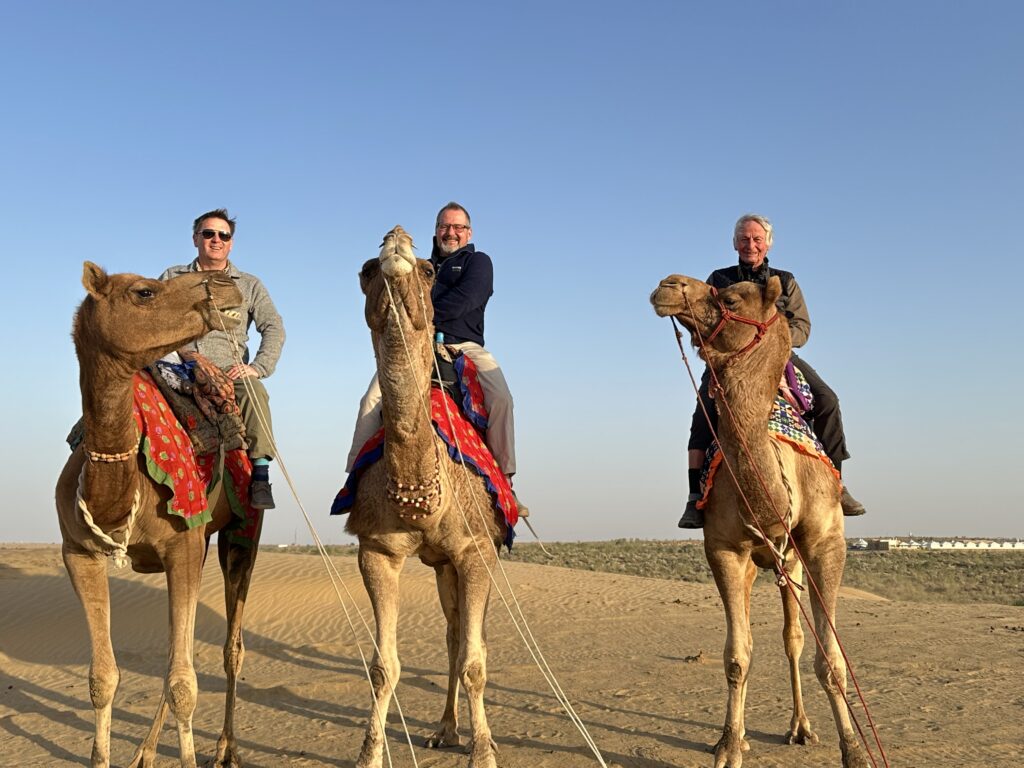
After we did our camel riding bit, we had dinner, watched their entertainment, and hit the hay. Hay for me was the cot (my turn) but said cot had only two short blankets (how can you have a “short” blanket?) and within an hour my feet were decidedly cold. Off I went, and dug some one up (the place had closed down) and rustled up warmth. The temperature, incidentally, did go down into the single digits that night.
11. Jaisalmer to Jodhpur (Sunday, Jan 25)
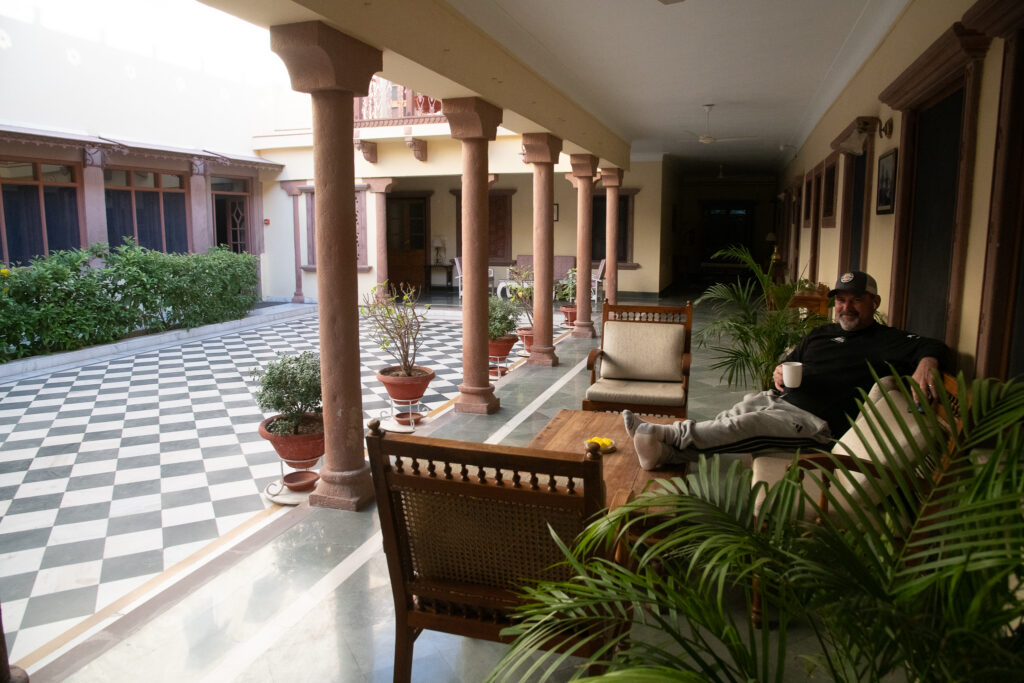
Long drive back to Jodhpur where we checked into a beautiful old hotel, the Rattan Villas. We sat out in the garden and ordered a Bombay gin and tonic. This is my idea of Indian life back when the British functioned as a sovereign power through the British East India Company.
Our dinner is worth briefly describing: Mutton Sheek Kebab (minced mutton, marinated in a ginger and garlic paste, skewered and cooked in the tandoor); Kadhi Pakora (a North-West Indian recipe of deep fried edible gram flower and onion fritters immersed in a well-spiced, sour yoghurt gravy); then a cooling pineapple raita to balance the spice and heat. A bottle of Chardonnay was consumed.
12. Amritsar, the Sikh capital of the world (Monday, Jan 26)
To get to Amritsar we left Jodhpur early in the day and flew to Delhi, then caught another flight from there on to Amritsar. It took nearly an hour to get to our hotel, the Hyatt Regency. As we started the day very early, we were fast asleep by 10!
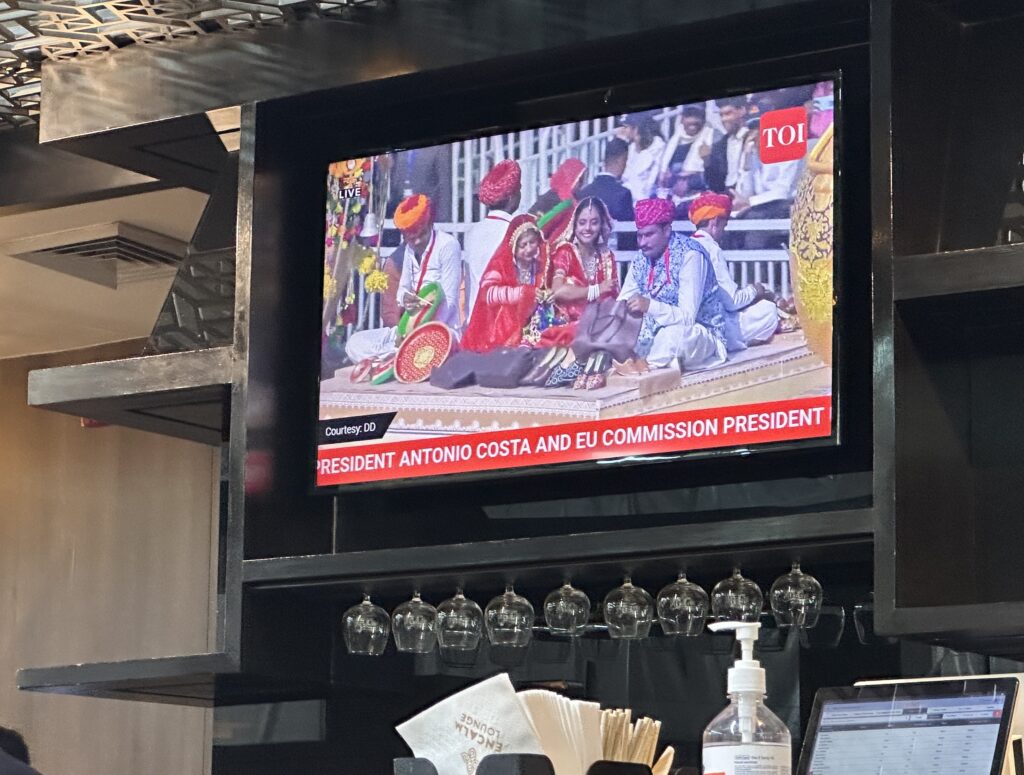
Today was “77th Republic Day” in India honouring the date in 1950 when India transitioned into an independent republic, moving away from a colonial-era government. There were lots of celebrations and big parades going on. Prime Minister Narendra Modi had two very important and symbolic guests: António Costa (the European Council President) and Ursula von der Leyen (the European Commission President). They all chaired the 16th India-EU Summit and finalized a major “mother of all” deals, a landmark Free Trade Agreement.
13. Golden Temple, Amritsar (Tuesday, Jan 27, am)
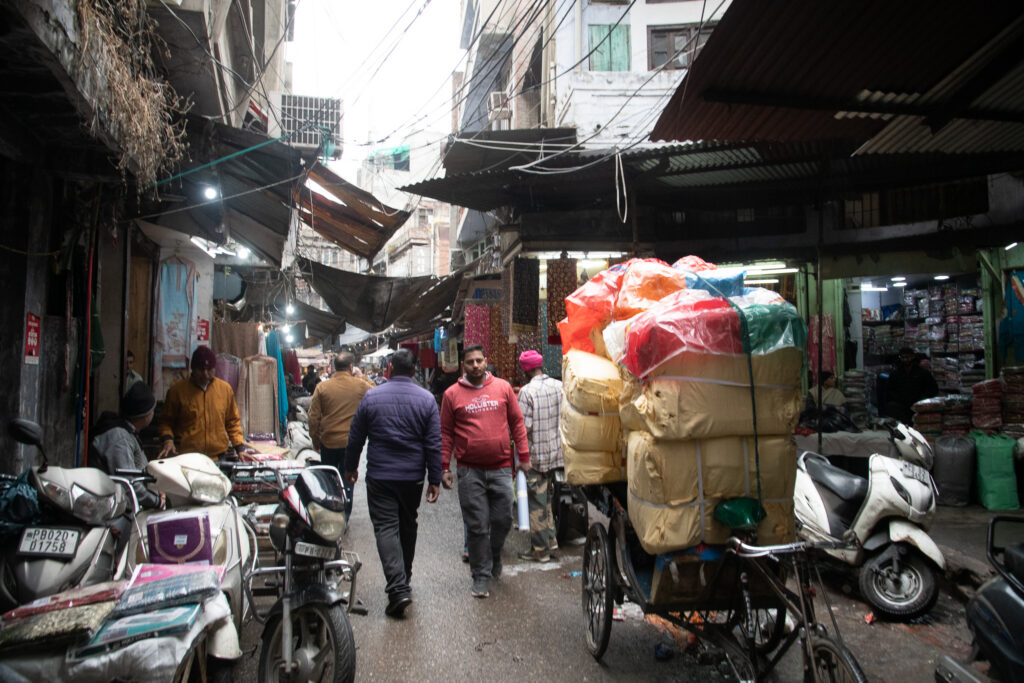
We were driven to the Golden Temple in Amritsar. The temple is spiritually the most significant shrine in Sikhism, in fact the pre-eminent spiritual site of Sikhism, so it’s a serious edifice.
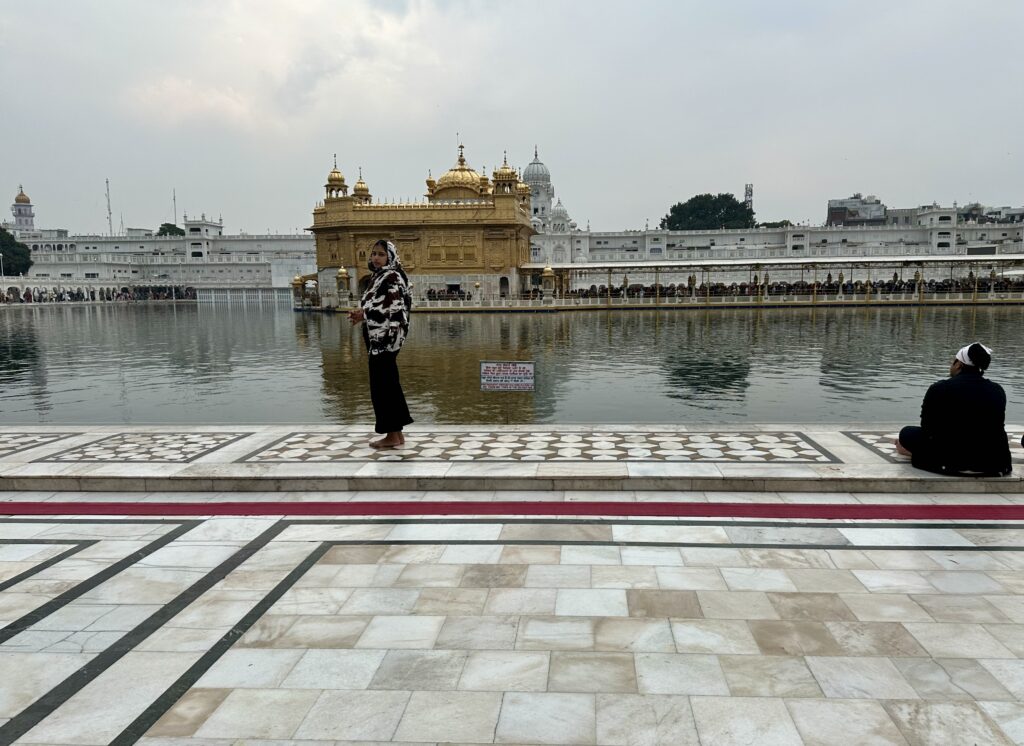
It has quite a history, that would take a whole blog to cover. Enough to say that while originally completed in 1577 it was destroyed several times by the Mughal and invading Afghan armies. The most recent incident occurred in June 1984 when PM Indira Gandhi made the decision to remove a militant Sikh leader and his followers from the buildings. It was a bloody operation and about 780 militants and civilians and 400 troops perished in a fierce gun-battle. Five months after the operation Gandhi was assassinated in an act of revenge by her two Sikh bodyguards.
The temple is an open house of worship for all people, from all walks of life and faiths. It has a square plan with four entrances, and a circumambulation path around the pool. The four entrances symbolize the Sikh belief in equality and the Sikh view that people from all groups, castes and ethnicities are welcome at their holy place. Apparently over 150,000 people visit the shrine every day for worship, so we were not alone (but few places in India give you that feeling).
As one can’t bring any bags into the temple we rotated entering the temple (after cleaning our hands and dipping our feet in the water pool in front).

By our own misreading of the directions after we had been dropped off, we had headed the wrong way. So we walked around a bit to find the temple, which turned out to be great as we were in a very local neighbourhood amongst all the wonderful chaos and traffic that these places deliver up. There were NO tourists around anywhere, so this was unadulterated India.
14. India/Pakistan “Beating Retreat” border “ceremonies” (Tuesday, Jan 27, pm)
Covered in main blog.
15. Amritsar to Delhi (Wednesday, Jan 28)
Flew from Amritsar to Delhi on Air India. It was a nice day, but still an enormous haze hung over the city. Over the intercom the stewardess said delightfully “We hope you had a comforting flight.” That is comforting, ah, to hear.
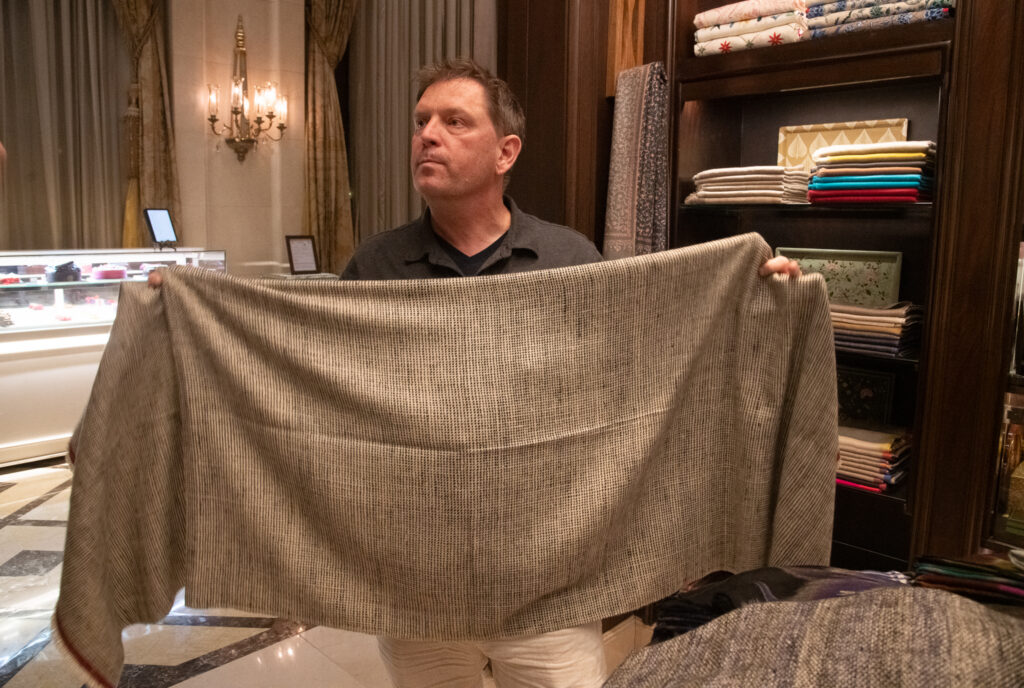
Brendan and I took a cab to the Leela Palace Bengalaru and in a beautiful shop purchased thick, hand-woven, greyish-brown cashmere shawls for Mel and Penny. Each one, they said, took 3 to 4 weeks to make.
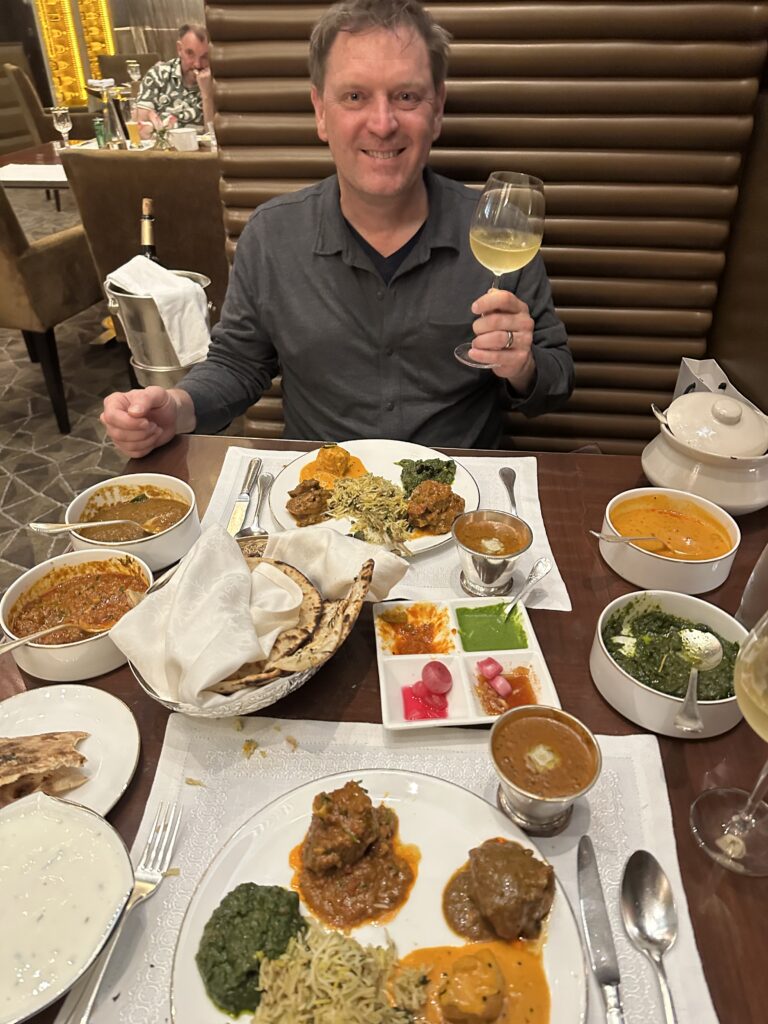
I then took Brendan out to a high end restaurant called Jamavar, for what turned out to be a superb meal. (Their sister restaurant in London has a Michelin star.) It was for his recent birthday, and of course we ordered what they recommended as their signature meal.
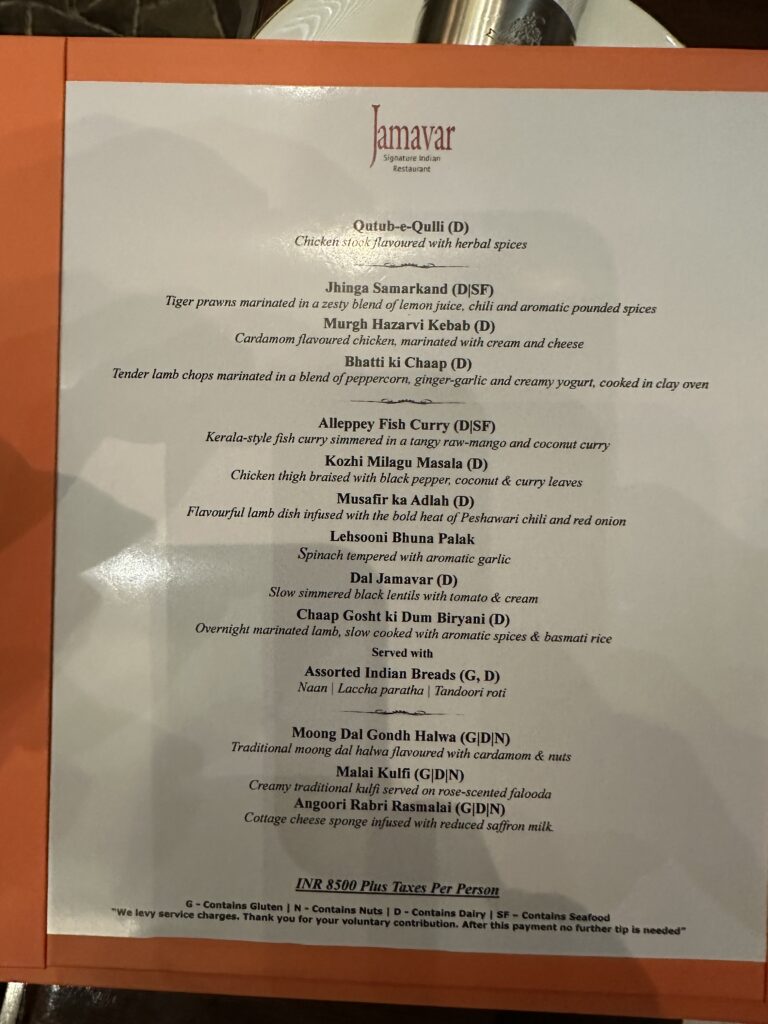
The starter was tiger prawns marinated in a blend of lemon juice; cardamon flavoured chicken, marinated with cream and cheese, chili and aromatic pounded spices; and lamb chops marinated in a blend of peppercorn, ginger-garlic and creamy yogurt, cooked in a clay oven. That’s what continued to serve us over the next two hours. The menu is attached if you wish to dig deeper.
16. Taj Mahal, Agra (Thursday, Jan 29)
Covered in main blog.
17. Agra Fort, Agra (Thursday, Jan 29)
A couple of kilometres away from the Taj Mahal is Agra Fort. It served as the main residence of the rulers of the Mughal dynasty until 1638, when the capital was shifted from Agra to Delhi. It was renovated by the Mughal emperor Akbar the Great (the third Mughal emperor).
It’s a massive fort; its walls are seventy feet high and very thick. Double ramparts have massive circular bastions at intervals. The fort was built with bricks in the inner core with sandstone on external surfaces.
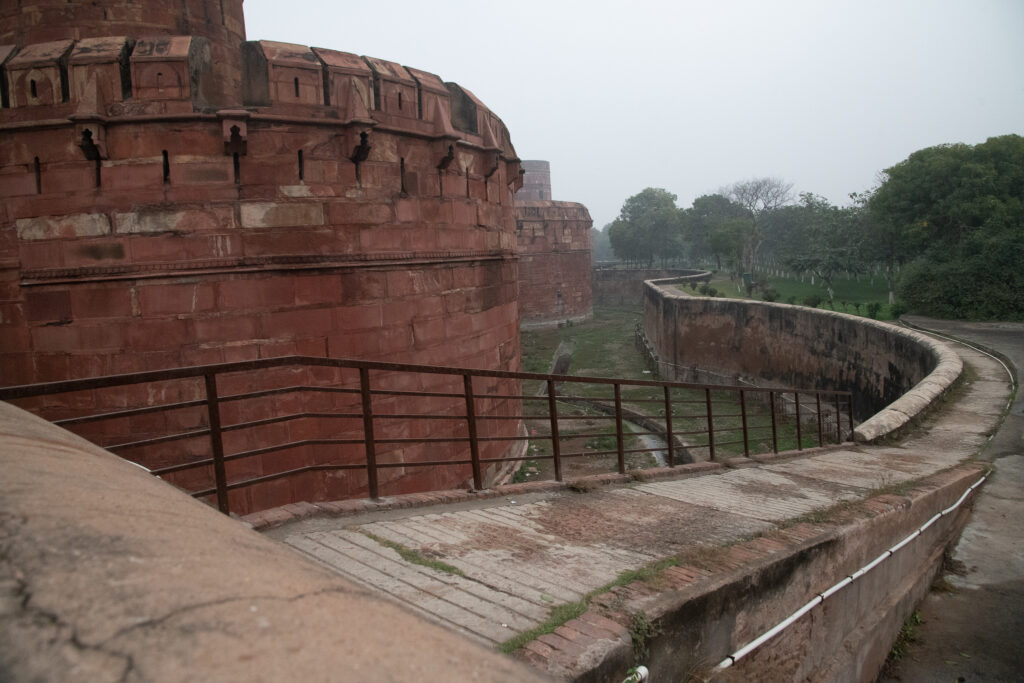
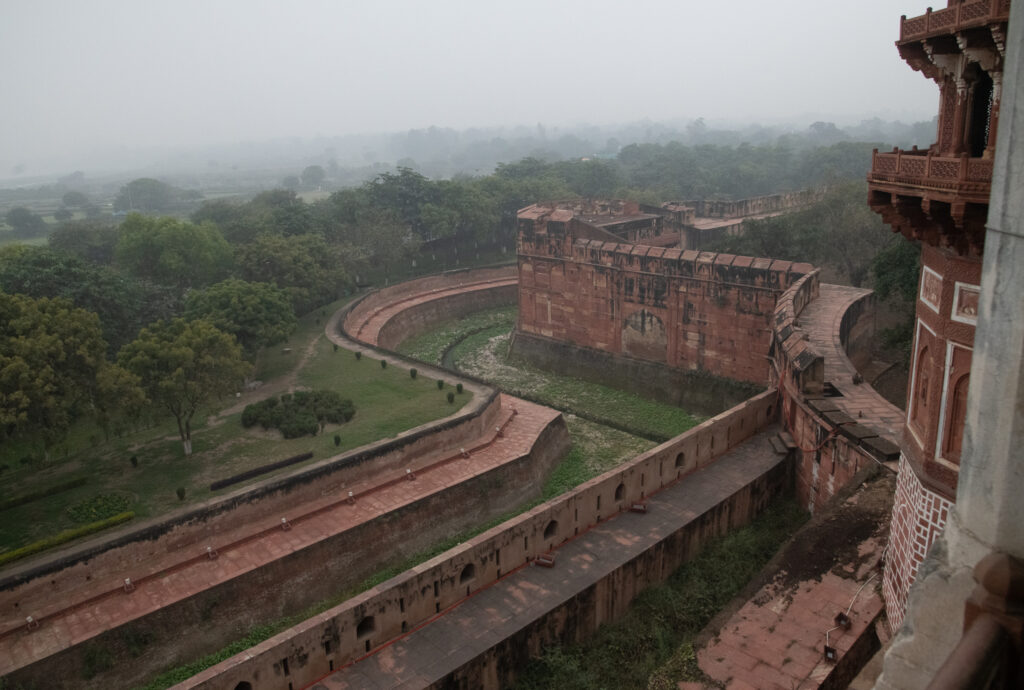
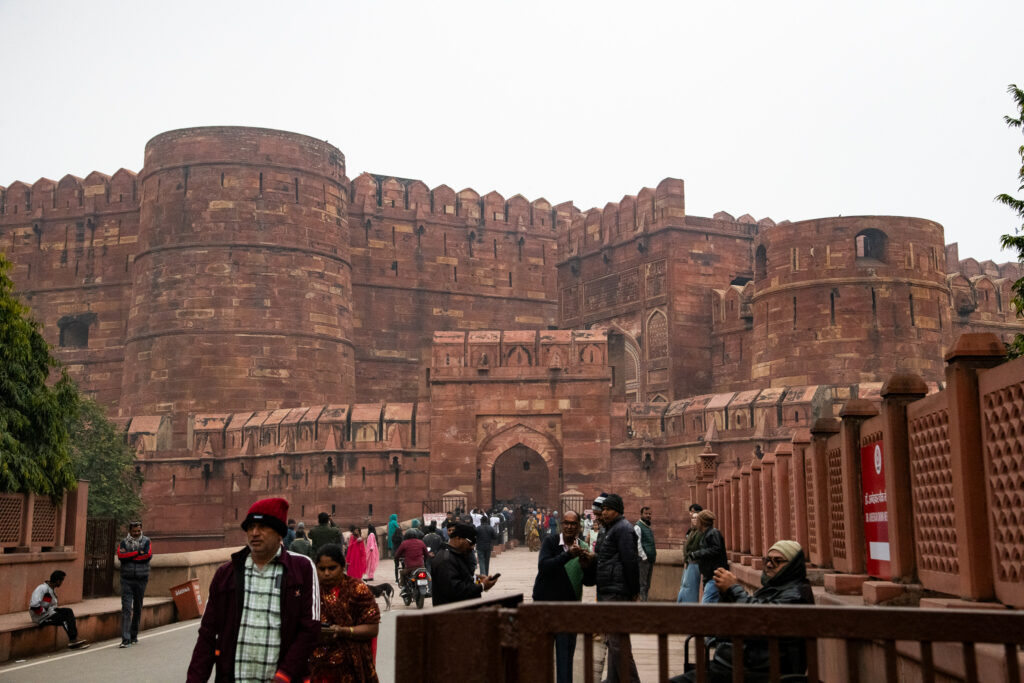
The monumental Delhi Gate, which faces the city on the western side of the fort, is considered the grandest of the four gates and a masterpiece of Akbar’s time. It is embellished with intricate inlay work in white marble. A wooden drawbridge was used to cross the moat and reach the gate from the mainland. Some 4,000 builders worked on it daily for eight years, completing it in 1573.
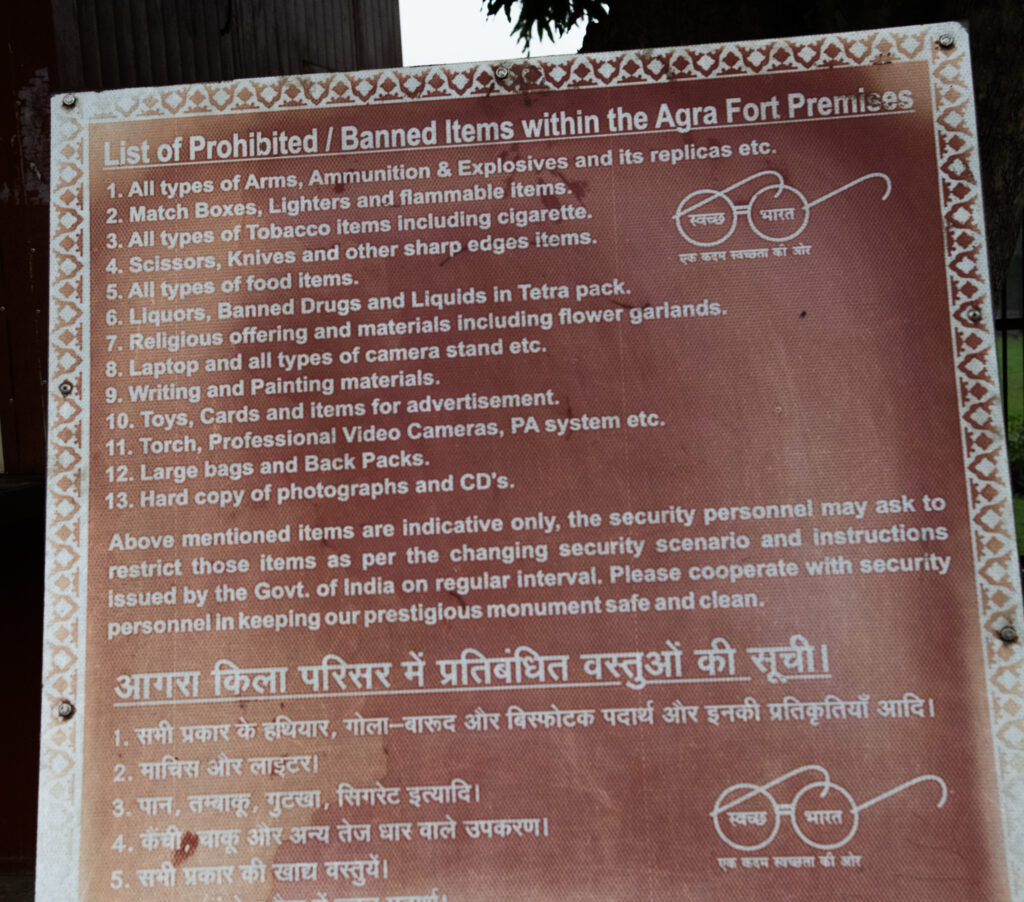
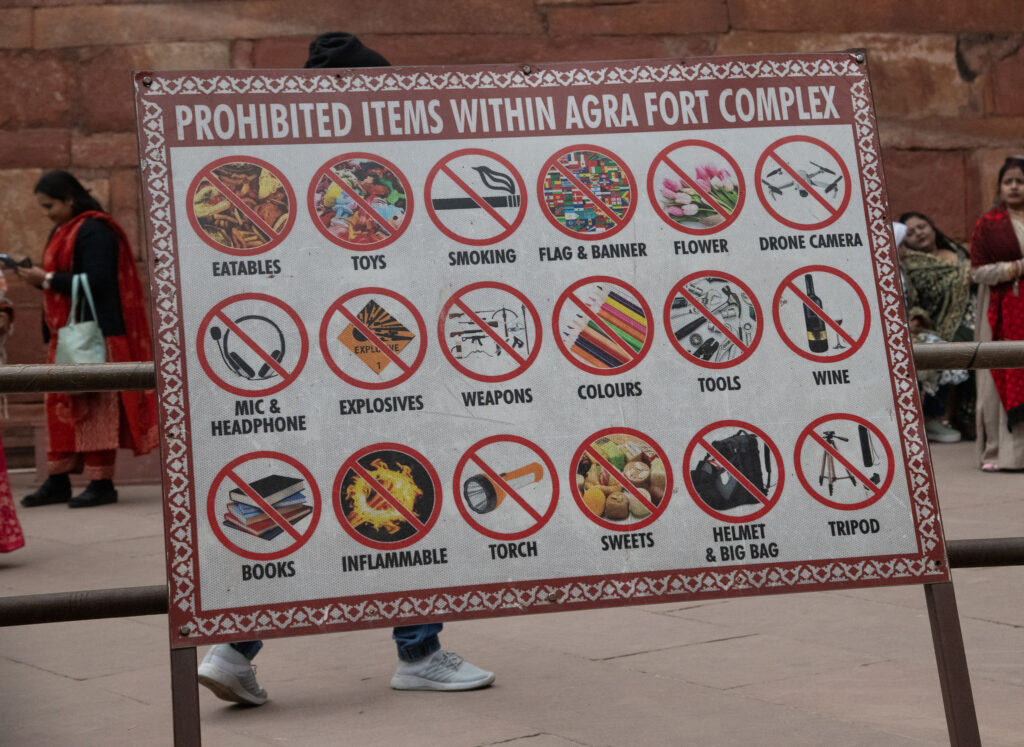
India tends to excess with respect to instructions and bureaucracy. Here are two examples at the same place. A sign listing “prohibited/banned items within the Agra Fort premises” and another with pictures for emphasis!
Our guide told us that there was a lot of internecine in-family rivalries going on. Apparently when Shan Jahan (the chap who built the Taj) fell ill, a bloody war of succession broke out between his sons, where one of them, Aurangazeb, was victorious. He would go on to place his father under house arrest in Agra fort!
The fort was the site of a battle during the Indian rebellion of 1857 which caused the end of the British East India’s rule in India and led to a century of direct rule in India by Britain.
18. Fatehpur Sikri Monument, near Agra (Thursday, Jan 29, pm)
After a one hour drive from Agra, we got to a small town, where a remarkably preserved “ghost city” exists, built by Emperor Akbar. It is a masterpiece of Indo-Islamic architecture, featuring red sandstone palaces, mosques, and notably, the Buland Darwaza, the largest gateway in India (54-meter high).
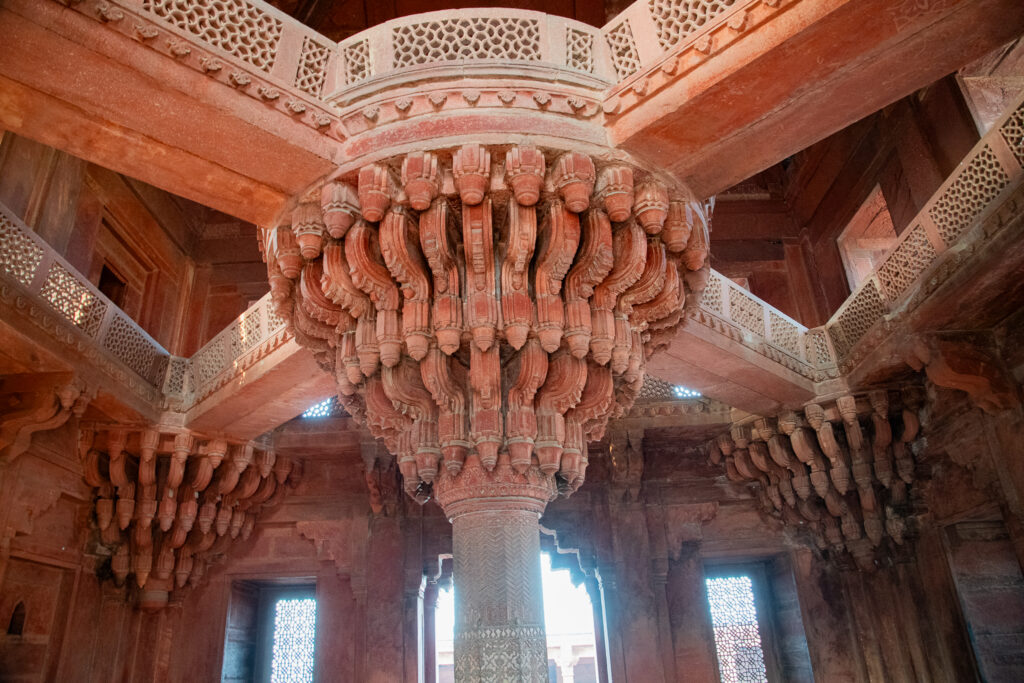
There are a number of impressive monuments in this place: a vast mosque containing a tomb; a delicate white marble structure; a small, screened structure intended for royal women; the Hall of Private Audience, which was built by Akbar, featuring a central pillar topped with a large carved capital that supports a walkway; the Palace of Jodha Bai, which is the largest and most important building of the Imperial residential complex named after Akbar’s Hindu Rajput wife, which has richly carved interior pillars, balconies, perforated stone windows, and an azure-blue ribbed roof on the north and south sides; and a large, open pavilion where the emperor met the public.
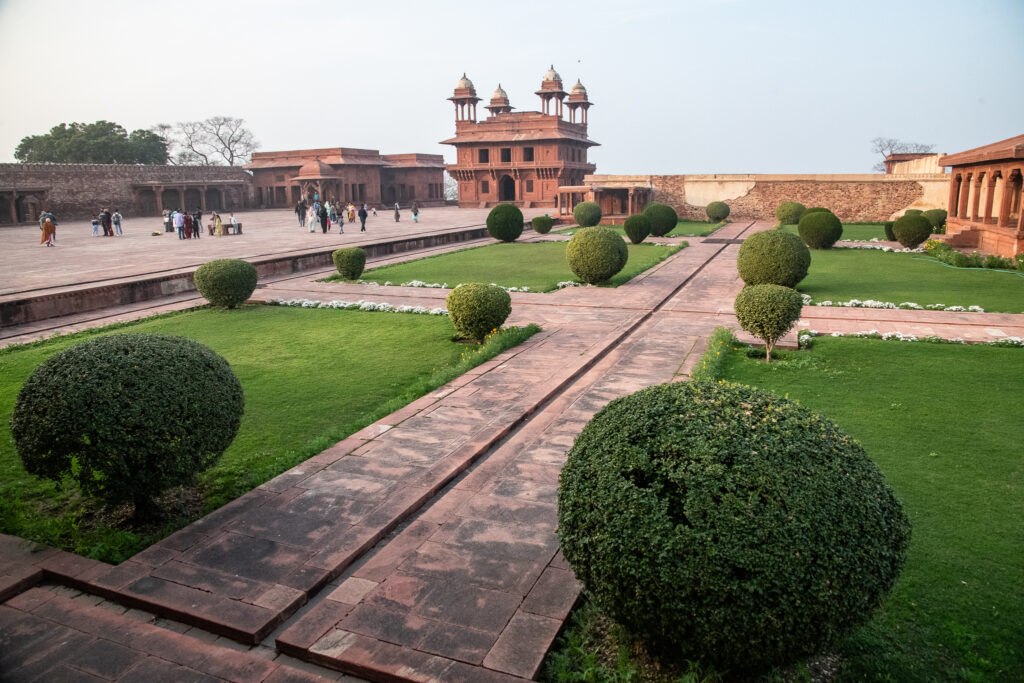
There were very few people exploring these places. For the first time in India, I felt a certain calmness, without the noise, and the people; a nice way to finish off quite a day.
Although it wasn’t quite finished. We still had an hours drive back to Agra and catch a train back to Delhi. As it turns out we climbed into our beds at 2:30 am, a long day from our 4:30 am awakening 22 hours ago!
19. Train, Delhi to Jalandhar (Friday, Jan 30)
Transportation day: long train ride from 3:30 to 9 pm.
20. Jalandhar (Saturday, January 31)
Then we were taken by Timmy Varuna, the father of one of Brendan and Mel’s real estate agents, to a place called Haveli (Rangla Punjab). It is promoted as recreating “the charm of an old Punjabi village with cultural performances, a traditional buffet, and engaging activities. A perfect destination to experience Punjab’s rich heritage”. We wandered around the place and then had a nice lunch. I particularly liked the cornmeal flatbread, makki di roti, which was served with a thick mustard green chilli cooked with spices.
Timmy then took us on a drive to his club where he showed us around and we had a drink.
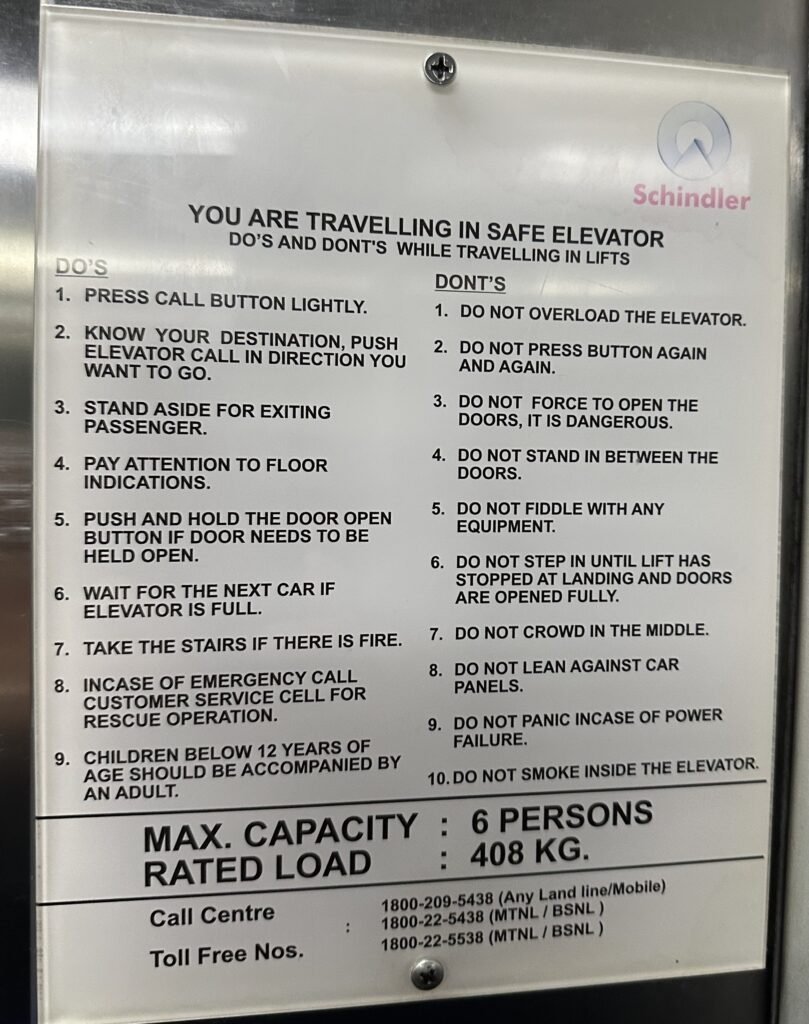
As I selected my floor in the hotel elevator some culturally interesting comments were posted. Like “Do not fiddle with any equipment.” And “Do not press button again and again.” Lucky I read them, as I was about to fiddle, again and again.
21. Jalandhar, then train to Delhi (Sunday, Feb 1)
Opening of the first MB Chicken outlet in this city. Covered in main blog.
Then a five hour train ride to Delhi.
22. Delhi and flight back to Canada (Monday, Feb 2)
We left late in the day for an Emirates flight through Dubai, where we laid over two hours. The flight to Toronto was 14 hours, arriving at 9 am Toronto time.