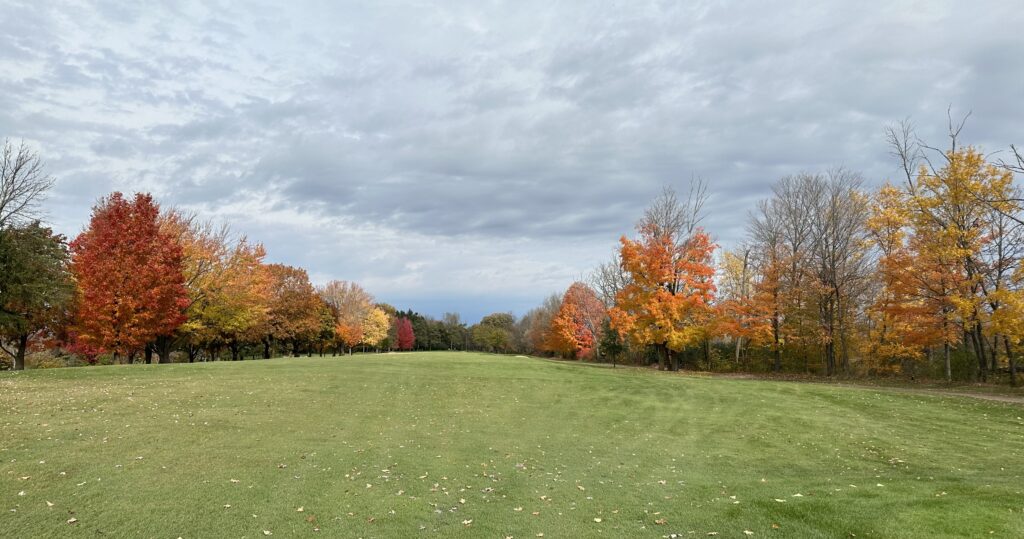
Surrounded in the colourful leaves of fall, the golf season has come to a close. So I thought I’d tackle the game in a more cerebral way and write a blog on the sport and my attempts to tame it.

So much has been/will be written on golf that I’m risking repetition, so this better be interesting. Not necessarily what Tolstoy or Shakespeare would write, but did they try writing on golf?
To start, full disclosure, you have to know that these notes are from a person who has little natural talent for the game. What ever talent I demonstrate has a lot to do with trying to transfer untransferable skills from other sports on to the antics necessary to go from tee to a very small hole 18 times with as few whacks as possible. Sometimes I feel like I’ve done a backward salto on the parallel bars, but it’s because I’m on the side of a steep hill needing five legs to brace as I’m making my shot. (One of my sports, in my youth, was gymnastics.)
Nor did I start in my prime. When I joined the Peterborough golf club I took lessons, age 70. The first thing Sylvia, the assistant pro, told me was to buy some new clubs, as I had my grandfathers wooden shafted antediluvian delights, with some of the twine holding the club together noticeably unwinding. I still have some of those clubs, as this picture proves.

For those looking to lower their scores with advice on proper club grip, how elbows figure in a productive swing, or what does keeping your eye on the ball do to the ultimate score (probably everything), you’re in the wrong spot. Quit reading now – I’ll get you a copy of Tiger Wood’s “How I Play Golf”.
Serious/cerebral vs light/humour
I have always recognized the allure of golf is a complicated one; not so much a love/hate thing because I don’t hate anything about the game (really, although occasionally you would’t know it) but there are so many variables (the adjective “masochistic” frequents my thoughts). I’ve always been a competitive sort so I have found that golf is a four letter word that makes you face many challenges. So there is a serious, cerebral side to the subject.
But the emotional, light hearted, and humorous side intrudes more and more. I didn’t know before I started to write this blog that this conflicting theme would emerge.
So, to the game. We have to reckon with the course, the weather, our mates, and the skills necessary.
Courses
Golf courses are made around nature. It’s amazing that when you go to play tennis, soccer, baseball etc. the dimensions, and makeup of the playing ground are very regulated and measured. When I played squash, I knew exactly how wide and deep the court was. Golf courses have infinite variety, which is part of the uniqueness of the game; playing the course as one finds it is part of golf’s character. Even the long history of the game hovers over what I have chosen to write, including golf as a professional sport, both of which I’ll only touch on.
With long grasses, trees, sand, rocks, hills, ponds, rivers, and even animals, no course is the same. There are those who collect golf courses, like I collect masks from around the world.
I read that in Scotland during the early 1800s, the first sand traps originated where wind and sheep created hollows in the sandy terrain. They of course served as challenges for golfers. So malevolent course designers made these sheep-created depressions intentional to test the players. (I do think a few sheep would give my club some character.) One course in Oregon has a program where goats carry golf clubs, balls, and drinks for golfers. I’m thinking, OK, so now a few goats would also add character. I can even top this with the alligator photo I took on a Hilton Head course last year.

Weather
Wind is a partner or opponent. When it rains, it often starts out tentatively, but I’ve noticed that we all have a different point we reach when the umbrella or cart roof isn’t doing it and the allure of a dry clubhouse seems more sensible.
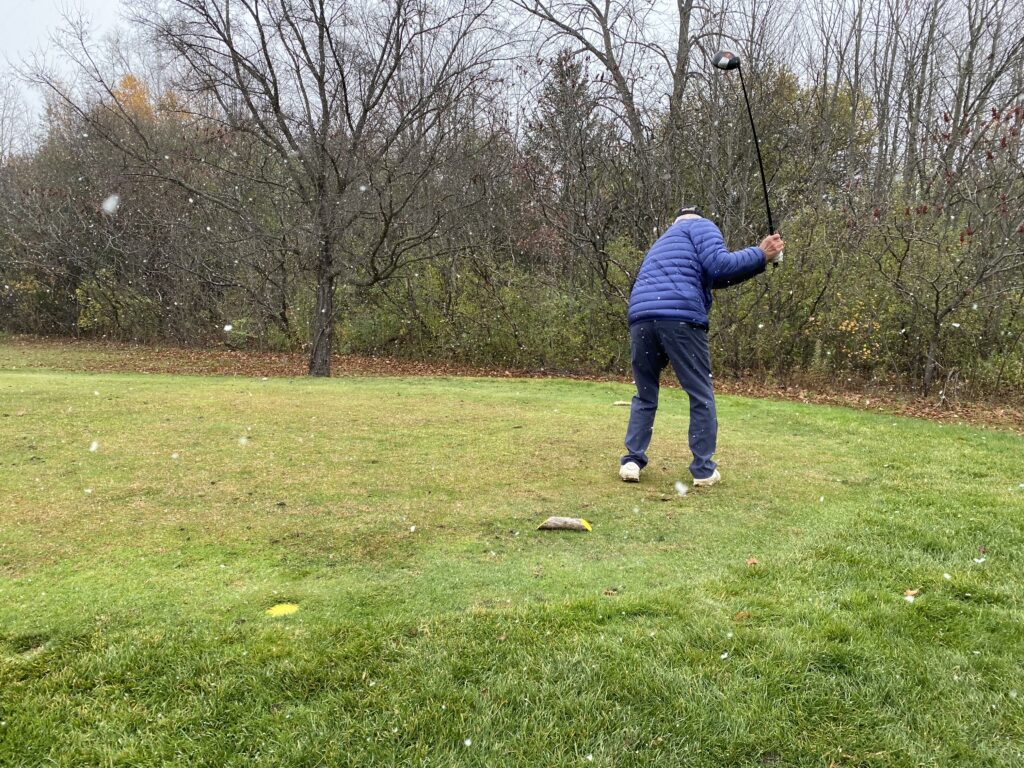
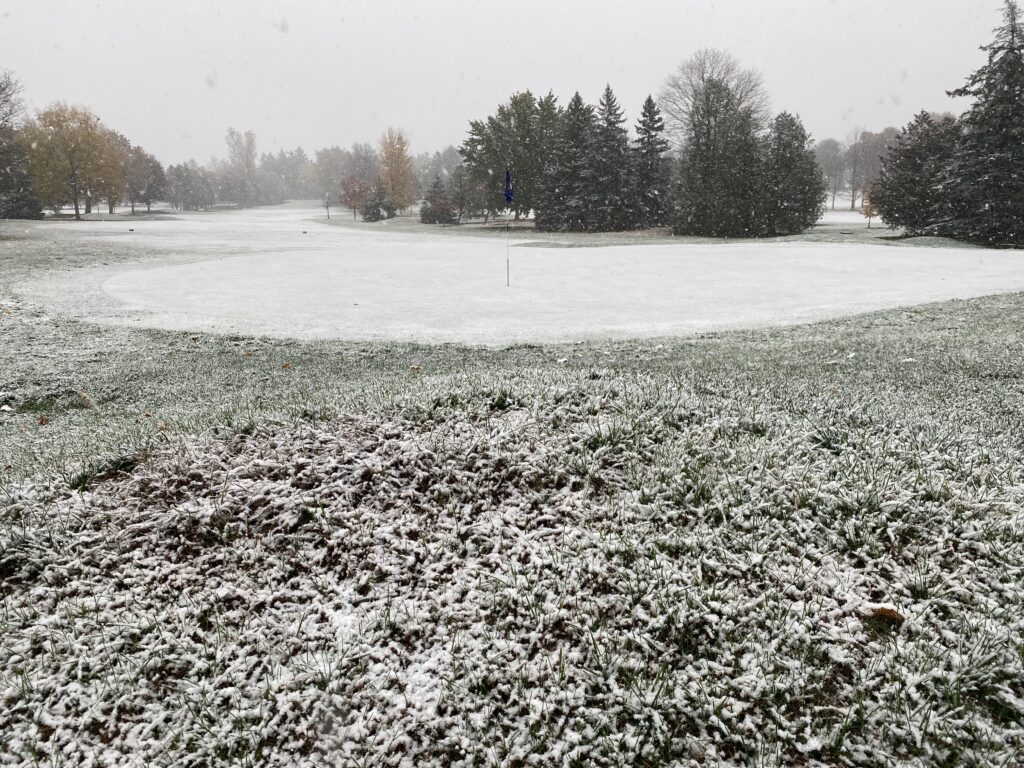
Your ball hides under leaves in the fall (how Canadian). I’ve even played when it snowed. As many Americans think we all live in igloos, they’ll take this as confirmation. (These pictures support my snow claims.)
Golf partners
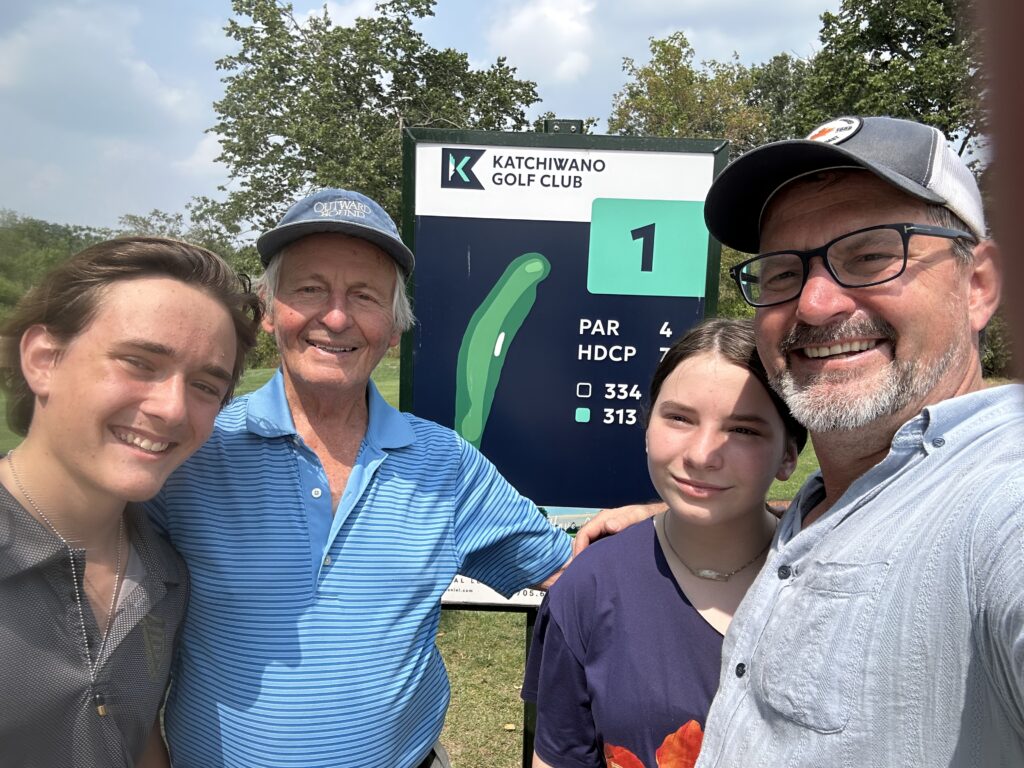
My golf mates add to the colour with their idiosyncrasies. (They may be now talking about mine!) Golf brings together diverse partners, from friends to grandkids. For the latter, it’s a terrific opportunity to connect. I’ve played with most of our eight grandkids at one time or another. This spring I played with my son Dylan and his son Ayden at the Katchiwano Golf Club. Dylan’s daughter Akira nonchalantly drove the cart while Ayden, Dylan and I played golf. Here is a shot of the four of us – a lot of smiles.
As it has been said “sports don’t build character, but they sure reveal it” and golf is a master at that. Warm-up rituals and quirks take place that, if not performed, the ball doesn’t perform. Incantations to golf gods, all manner of practice swings and lining-up rituals, favourite balls on special tees – they all appear.
And that’s just the drive. Fairway antics include measuring distances to the hole with special devices. “It’s 188.5 yards away” assumes one can do something useful with the information. There is much back and forthing with club choice, choosing one that will work and ignoring those in the bag that never get used.
All golfers are addicts; they occasionally get “pellets” in the form of a good shot. I’ll explain.
Golf is the perfect example of intermittent reinforcement. Experiments with rats help us understand. If sometimes (but unpredictably) a rat pushes a lever in his cage, a pellet comes out and sometimes it doesn’t, the rat becomes anxiously obsessed with the lever and neglects all of its other grooming habits. The rat is engaged in an intermittent reinforcement experiment. And the intermittent reinforcement creates an addiction. So we are like rats. Intermittently we get a good shot, and thus we are driven to do it again.
So to skills and attitude
This is not a golf primer, but I borrowed such a book from my neighbour. It was written by Harvey Penick, a legendary golf instructor in Austin, Texas. The tome, entitled “Little Red Book” was a collection of aphorisms, tips and down home advice over his 60 years teaching golf. Example: “In golf your strengths and weaknesses will always be there. If you could improve your weaknesses, you would improve your game. The irony is that people prefer to practice their strengths.” He says too, that you need to play golf to be humbled, and so right then I knew he was making sense. Read his book for this kind of advice.
For me the primary skill is a sense of humour. If you are going to attempt to encircle a golf course accompanied by 14 clubs of all types, and use these to hit a 1.68 inch diameter dimpled sphere over a clever collection of manicured fairways and foulways, including as I mentioned other variables, humour is pivotable.
One of my good friends (OK, OK it’s Jim Stewart) likes to call the game “whack fuck”, which does have a certain resonance to reality as this golf school cartoon highlights.

Humour has to be metered out to fit the audience, though, as it comes in many colours: sardonic, satiric, dry, twisted, slapstick, and even lack thereof. So know your audience before delivering a gentle jab (such as “that’s great shot, even with that swing”).
Some golf announcers use humour well. David Feherty the CBS announcer apparently comes up with a few dandies. I like this one: “That ball is so far left, Lassie couldn’t find it if it was wrapped in bacon” and this, his rude pejorative describing V.J. Singh’s prodigious practice regime – “VJ hits more balls than Elton John’s chin”.
The second skill is to understand and deal with how your personality is misaligned with your game. This for me means a couple of things. I do things quickly. But golf needs to have you be deliberate. Almost every time I bring my club back quickly, I pay the price.
The other one is power; I would like to hit it farther, but every time I put a lot of willy into the shot, it bites back. “So, slow down, take your time and don’t overdo it” I say to my self. But my self isn’t listening. As it has been said “the game of golf is 90% mental, and 10% mental”. (When Penny read this joke, she didn’t get it!)
The third skill is an attitude one brings to the course. On my home course, the Peterborough Golf and Country Club (why “country” I don’t know; it’s in the city), over my 14 years of playing golf there (the club was almost my first golf date other than charity tournaments) I likely have parred every single hole at one time or another. Serendipity does strike, and I think, optimistically, it can strike again. Certainly not all 18 holes, but maybe a group of them could get together and let this guy have some joy in producing a string of pars. This is a motivating hope. But for some reason this ‘dipity stuff never strikes.

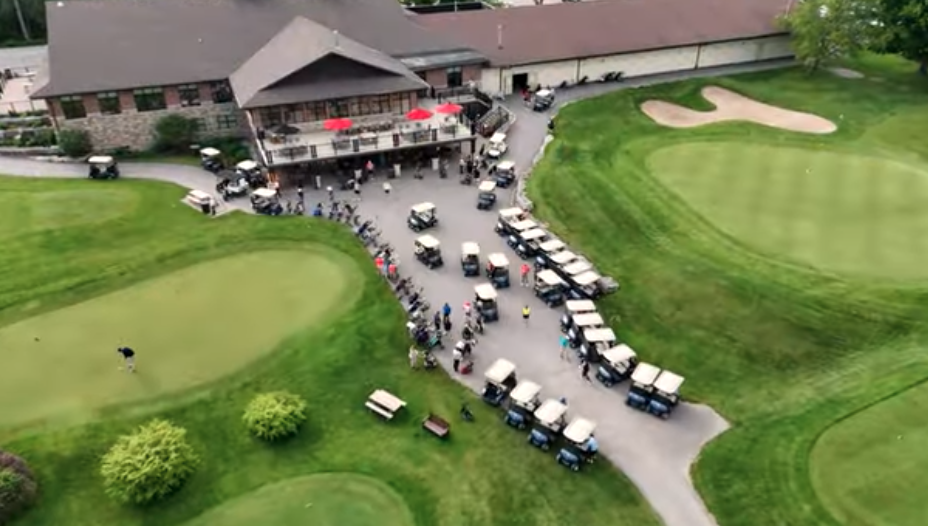
One feature the game has is that we play the course, mostly. The handicap system, if one followed it, allows one to play those a good deal more (or less) competent – a clever idea. That disguises the obvious: the reality that not all of us are competent. So we play by our own standards based on past performance. It allows a smidgeon of dignity, even when one tees off on a different set of tees.
Thinking creatively
I have given some thought regarding how I would revise the game. For sure I’d keep the variety of holes on a course, and courses available to play. That’s great. Sure, also keep the damned sand pits and dunes. And par fives that one can only reach in bogey territory. And of course, all trees are sacred. (How will Michael handle this next shot?)
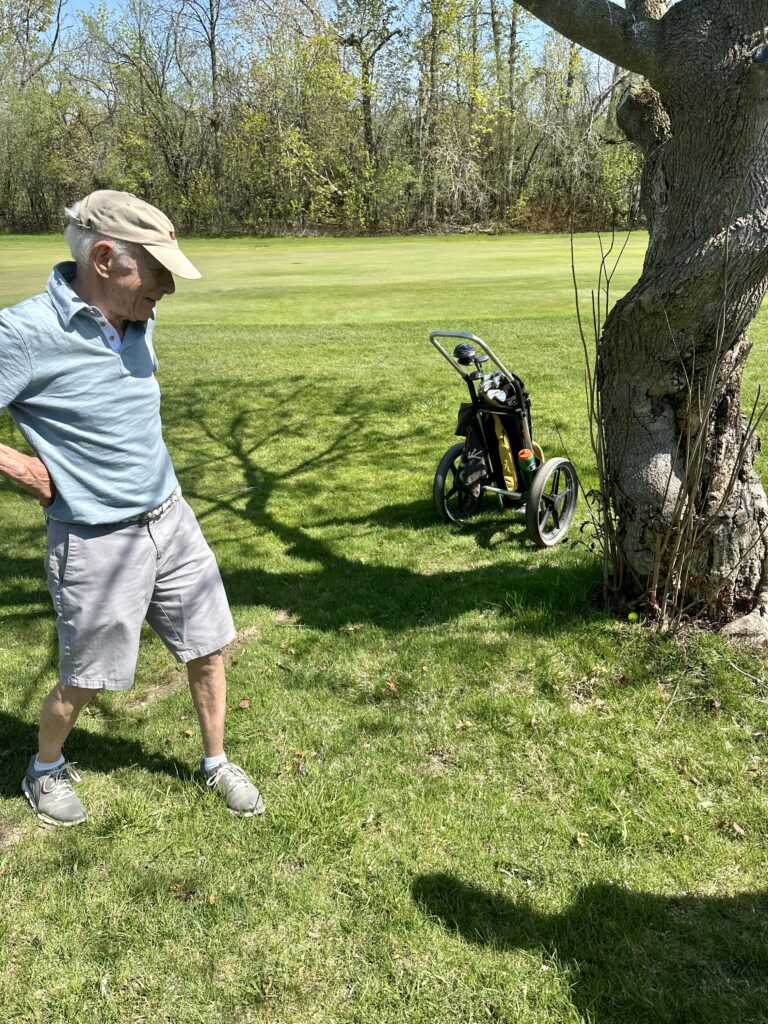
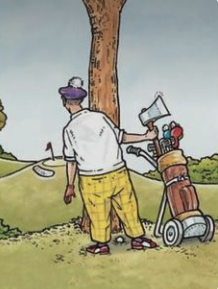
But the score card could be more innovative. Mere numbers lack colour and nuance the game provides. I would leave room for a comments section. Both D and Gs (disasters and glories) must be recorded. Not for every hole as D and Gs don’t happen on every hole. But the time your drive on the par 3 twelfth hole landed on the hill to the left, scooted on to the green and headed for the pin, skirting it by the thickness of a tee thus missing the hole-in-one you deserved. This needs to be written down, not just the number 5 (which is what you ended up with as you took 4 more strokes to put it in the hole because you read the green wrong coming back.)
You will find this score card innovation useful in replying in quick summary form to your friends about the game you played. I would use it when answering Penny’s usual query “How was your game?”
And how about some bonuses for exceptional play. A series of judged “credits” should be available for certain exceptional moments. For example an excellent putt that just doesn’t drop gets a -1/2 stroke bonus; any drive that truly finds the sweet spot so that it ventures at least 25 yards more than normal, or a chip toward a group of trees that makes it through (because you aimed at the centre tree knowing that in doing so you would never hit it) gets a bonus (remember bonuses are negative points – we’re trying to break 100, or even 90 here!) (Each foursome forms a three person jury for these kinds of shots to make their decisions.)
It is important to savour great shots. While they don’t happen a lot, they do happen. Included in this, we can with amusement remember the unusual shots. Once I hit a tree at its base; the ball ricocheted straight up, followed the curl under a branch and shot straight back at me, where I instinctively caught it – and tried again! These are the ones we talk about. Your memory of a recent stretch of golf may come down to two or three shots that bring you pleasure.
Now to the question of the second drive that is often taken – a Mulligan. Usually the rationale is you’re on the first hole and of course not warmed up (or cooled down from the drive to the course, or whatever). Thus the concept of an extra shot. Should the Mulligan be institutionalized on every hole? A reasonable argument is that in tennis, everyone gets a second serve. If this has merit in tennis, why not golf?
A tricky one is the “give me” putt – a delightful convention for friends. Where do you stop, you say? The whole game could be one big gimme. (I admit I think about that.) After much thought, my competitive instinct is to never give or take them. Hitting into the hole seems to be golf’s purpose, like putting gin in a Martini. You shouldn’t cut it out.
Sone random observations
I’ll wrap up with these observations.
First, surprisingly, the game does not embrace garrulous sorts as it offers fewer moments for conversation than one would expect. Over four plus hours you need to remain silent (yes silent) when driving, and once that’s done all four of you are off to pursue the next shots on the fairway (hopefully) often separated quite a bit. On the green, silence is also your duty while your partners concentrate.
Second, in traditional golf a “good” putt goes in the hole. A “nice” putt that just misses the hole is not nice at all; it’s useless. It may elicit a compliment, for being nice, but you don’t bank compliments.
Third, frailties creep into the equation. One is eyesight. Now that my cataracts have been corrected I’m the seeing eye dog for some of my mates, plus locating drives for lads who’ve forgotten where they hit.
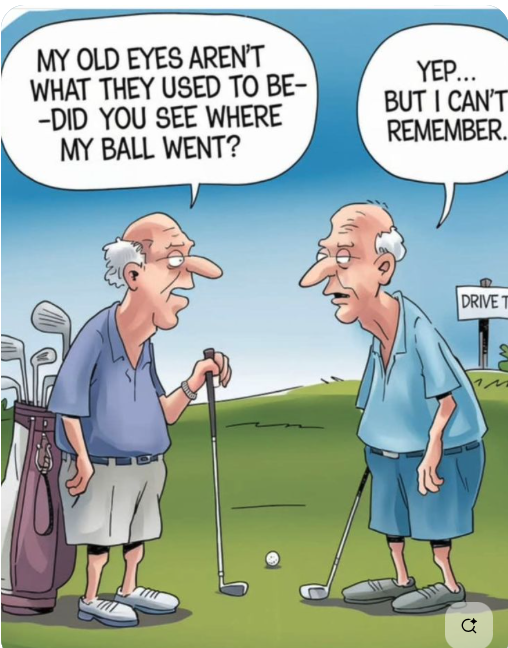
Fourth, our drives and long irons will continue to diminish in length; thankfully chipping and putting can go on forever.
Fifth, carts to carry you and or your bag are generally being employed. The automatic bag carts some use can provide humour. Occasionally my good friend Don Harterre forgets that he has activated his automatic golf cart remote, and the cart has been spotted tearing across the fairway at high speed. It has a sixth sense for water. I carry my cellphone/camera so I can support this claim. If you send me 5 dollars I’ll promise to activate an amusing video of it being removed from a pond.
Finally, the game is not, as Mark Twain was supposed to have said “a good walk spoiled” – it is enhanced by golf. (Lee Trevino said it was the most fun he ever had with his clothes on.). Golf courses are really great places to be, outside in a pleasant environment even in most weather.
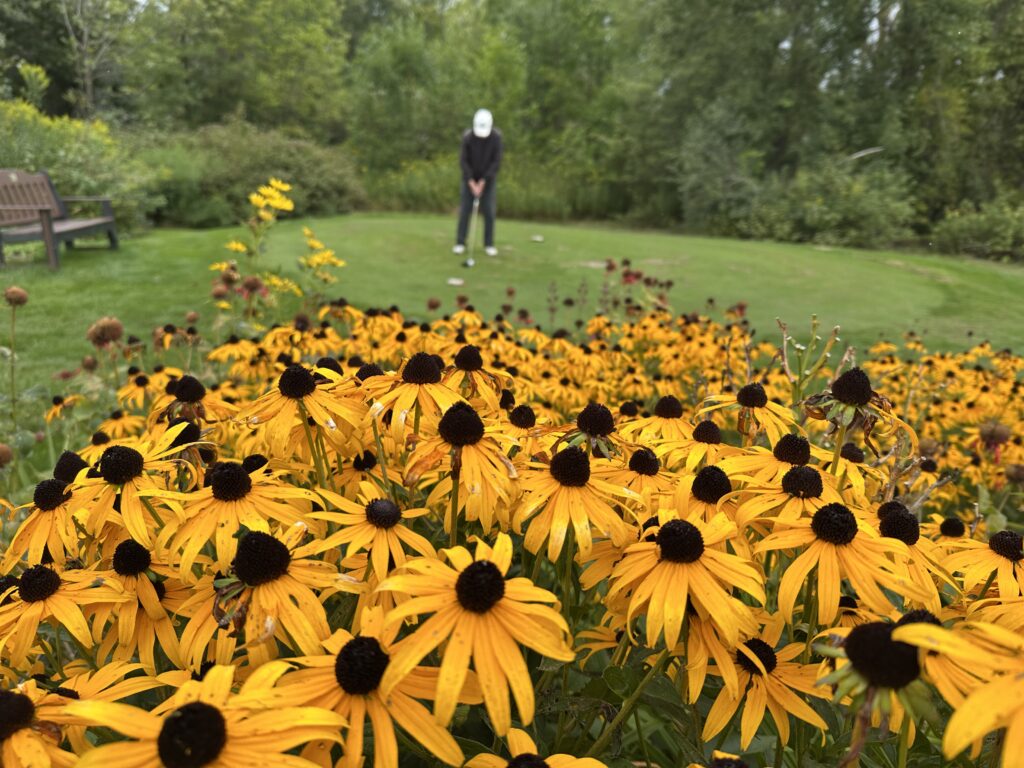
Here is a photo of a friend about to tee off, under the gaze of some watchful flowers.
Professional golf
Regarding professional golf, I know little, but realize the game has a colourful history. And certainly a range of amazing courses. Golf fans have quite a choice that range from the highly manicured, sometimes over designed North American courses, to Ireland and Scotland, the bedrock of golf’s history, where courses are more shaped by nature, usually near the sea with driving rain and wind often as your companions.
The idea of playing say the Old Course at St. Andrews near Edinburgh, perhaps golf’s birthplace, or the “bearded bunkers” of the Royal Count Down course near the Mourne Mountains and the Irish Sea, tantalize many.
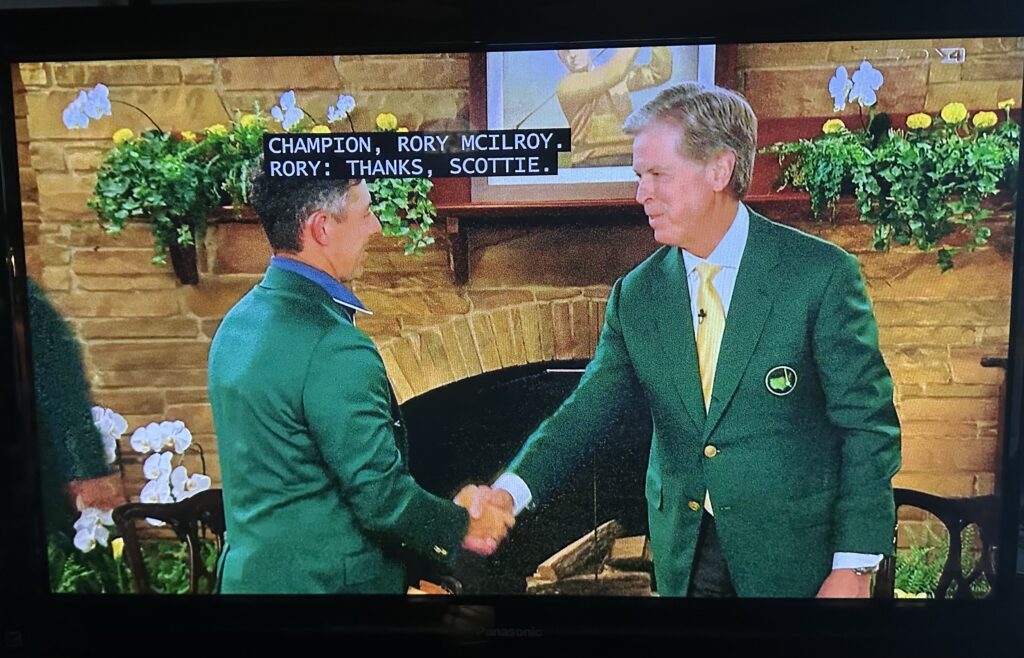
I did get a lot of pleasure last April watching Rory McIlroy finally win the Masters, completing the career Grand Slam. After a dramatic final round that included a near-collapse and a shaky finish, McIlroy sank the winning putt on the first playoff hole. The victory was the culmination of a long and emotional journey that seemed almost story book – the way the world should unfold in these troubled times in which we live.
Final don’ts:
- Never go into the club championships; you can potentially be awarded the worst shot award, or the most likely to improve (which means you have demonstrated that you have been the worst out there).
- Never get attached to your ball. I am not “one” with my ball. I have no allegiance to it; it is a very transitory part of my life, a floozie if I was honest, that I have picked up behind some bush, after which I have had my temporary way with. I am used to parting company with these found objects. It will continue its trollopy ways when I bang it into some heather ready to be picked up by another john.
..and dos:
- Occasionally leave your score card in your cart for viewing by the back room golf staff, but with a mock round of superb golf marked down on it. (“Did you see that guy in the garish yellow shirt; his card indicates he shot a 73, and he looks old; amazing!”)
- I figure I spend a good number of hours each week playing, so should at least have some standards. Mine are: play from where you hit it; play the course as you find it; count all the whacks and keep it moving.
- In the clubhouse, buy a round; it was worth it.
- Enjoy the course, your partners, and the fall colours.
Wonderfully done. I concur with every comment about the old game. I was thinking of doing my presentation on the game bud chose the ball instead. You have tickled my funny bone many times as I read your tales.
I agree that it is in the humor of the shared experience that the real fun resides.
Well done. Missing you in Hilton Head, this year. Here now wth Jim And Judy Dunn.
Just great Ken
I’m still playing and walking the course here in Collingwood 3 times a week.
I thought I had driven one of the best drives in quite a while and it measured 167 yards.Sure glad they have senior tees…..Always enjoy your writings
Thanks
Doug
Hi Doug,
I just had lunch with your brother David (with whom I met and played golf with this summer and fall) along with my old UTS pal, Mike King and four others.
I assume you know Ken Powell from Ahmek; we are in a book club together.
I have great memories of our times at Ahmek and the K-W Racquet Club.
I send greetings and trust you and your family are thriving with life in Collingwood. It would be great to meet up some time.
Cheers!…John (Fauquier)
Thanks Ken. Another cracker. Please put me down for a copy of “The History of the World” when it is done and dusted. A final thought from my daughter, who fancies herself as an amateur psychologist……the reason why men love golf….”they can spend 4 or 5 hours with their good mates without feeling any pressure to make polite conversation”!!
I can no longer golf, but still miss the five-days-a-week routine we enjoyed for so many years in Florida, and at Nottawasaga in Ontario. Thus, I enjoyed your perambulation around the links very much.
By the end of my ‘career’, my own method to alleviate the stress and enhance the enjoyment was to count only the shots I liked.
A. Great review of the game I played and loved from 16 to 87 with the exception of 5 years for 4 children .I have played with high and low handicappers and for the most part enjoyed it all .For the most part it was a good social outing and not too competitive It was never a good walk spoiled Jack A.
Ken,
You are almost turning into a P. G. Woodhouse! You are also a master of time as you are able to play an amazing amount of golf along with the rest of your decathlon of endeavours although I was amazed that you did not include why the game is called golf. (Ask Jim).
I played a little when I was much younger than you when I started but failed to distinguish myself but have played (golf) with Sandy for our pleasure for well over 60 years. I did get an Ace about 50 years ago and Sandy got one a few years later at Huntsville Downs. She did that after we played a round with Jean and Chris Chapman in Braemar Scotland. It was a unique game with one partial rental set of clubs, gorse everywhere and any course grooming was done by a flock of sheep. We camped beside the first green in our 2957 1100cc VW camper conversion after visiting the century-old primitive ‘club’ house. We played another unique game at Wanaka, New Zealand where they charged us for a pencil to record our scores.
I do remember a recent golf game with you in Hilton Head when we were pursued by an attractive damsel with numerous shopping bags in the middle of our game (!)
I can’t imagine what is coming next from you but put me on your History list. That’s how I studied history and thought that my approach was not optimal.
i thought that i saw you golfing in your brown hockey pants at one time …..
and remember when you drove (the ball) down an oncoming fairway to the left …and nearly bonked a Bermudian lady golfer …..much to her surprise. !!
oh..golfing with Ken ….
Ken,
A neighbour spent much of his life on the local golf course. I recall meeting him on his way home, as he said, “to a hot shower and a cold shoulder”. They divorced soon after. He still plays regularly.
I enjoyed your random thoughts!
I have been playing the game for over 60 years. At one time played the game well. Now I play trying to avoid pain. Always enjoyed taking money out of the pockets of my golfing buddies. Many great memories and thank you Ken for your well crafted thoughts on the game of golf.
Ken & I golf twice a week with 12 other golfers all over 80 years of age at The Peterborough Golf & Country Club a Stanley Thompson designed course. Most of us do not keep score & enjoy the challenge of the shot at hand instead of fretting about the result. This allows us to enjoy an “unspoiled” walk in the park with a group of friends. By the way i never considered myself to be a “real” golfer
Ken, what a delightful read, helping me to recall much of my enjoyment with the game.
I have parallels to your stories. Growing up in Hamilton, my father’s clubs were discovered in an attic storage area. I recall his telling me the name of two of the wooden shafted clubs, mashie and niblick. I needed to Google those names to check for spelling and was surprised, names were given to all the clubs – spoon, brassie, etc. Wikipedia provided a complete list with comparisons to the current numbering processes. With my father and his clubs, I started my golfing adventures.
And there’s your tree story that reminded me of a similar experience. During the 60’s, I played weekends at the Rockway Gold club in Kitchener, driving there from Toronto. Our foursome was setting up on one of the longer holes, the fairway stretching out in front of us, a small creek to the left, winding its way down the fairway, a small footbridge about 50 yards from the tee, and a large tree to the left in line, a short distance from the footbridge. I drove off, a terrible drive, directly into the tree. We heard the ball bouncing several times against the large branches. And then it appeared, nonchalantly rolling along the grass to stop unconcerned in the middle of the footbridge, daring me to hit my second shot from where it sat!
I stopped playing in the late 70’s, early 80’s as our family toured Ontario towns for fastball games and synchronized swim meets. These days I’m relegated to a yearly 3-put contest at Centennial Park golf facilities in Mississauga, organized by our Probus club. But maybe I haven’t completely lost my touch – last outing, tied a lady for first place ! ! !
Thanks Ken . . . and I look forward to your book
Ken, I love your stories — and I share your passion for the game.
While playing in Scotland several decades ago, one of my playing partners had a most distinctive caddie: jacket and tie, peaked cap, and thick rubber soles on his shoes.
After a couple of holes, I asked how long he’d been caddying.
“Forty-three years,” he replied in his thick Scottish accent.
Then he added, “I’m Arnold Palmer’s caddie.”
Sure enough, it was **Tip Anderson**, who had been assigned to Palmer on his first trip to The Open — which, if memory serves, Palmer won. Palmer stayed loyal to Tip for the rest of his life.
Tip worked at the Old Course, where the starters matched him with players who would appreciate his experience and stories. After the rounds, Tip would often join the players at the pub — no doubt holding court with tales only he could tell.
I am not a golfer. But I enjoyed your blog on golf.
In fact, I enjoy reading all of your blogs
I look forward to reading your upcoming book –
Lionel Colman
I always love your blogs Ken, this one is a real treat. This makes me remember a game with Andy Harris from LCS, when on the 5th hole he sent his drive into a huge tree on the rhs, the ball stayed there in the crook of the tree for two weeks…..he asked me what he should do, I said just play another ball, that one isn’t coming down, don’t take another stroke for a lost ball… ha ha
Great read Ken – I can certainly relate to what you have so well written. The personal dynamics and fellowship are what I really treasure as I play. The inevitable “power outage” keeps getting worse but we must just continue. Remember we are playing against the toughest opponent possible – ourself! Just enjoy and don’t take it too seriously – enjoy the experience as long as you can!