Geography
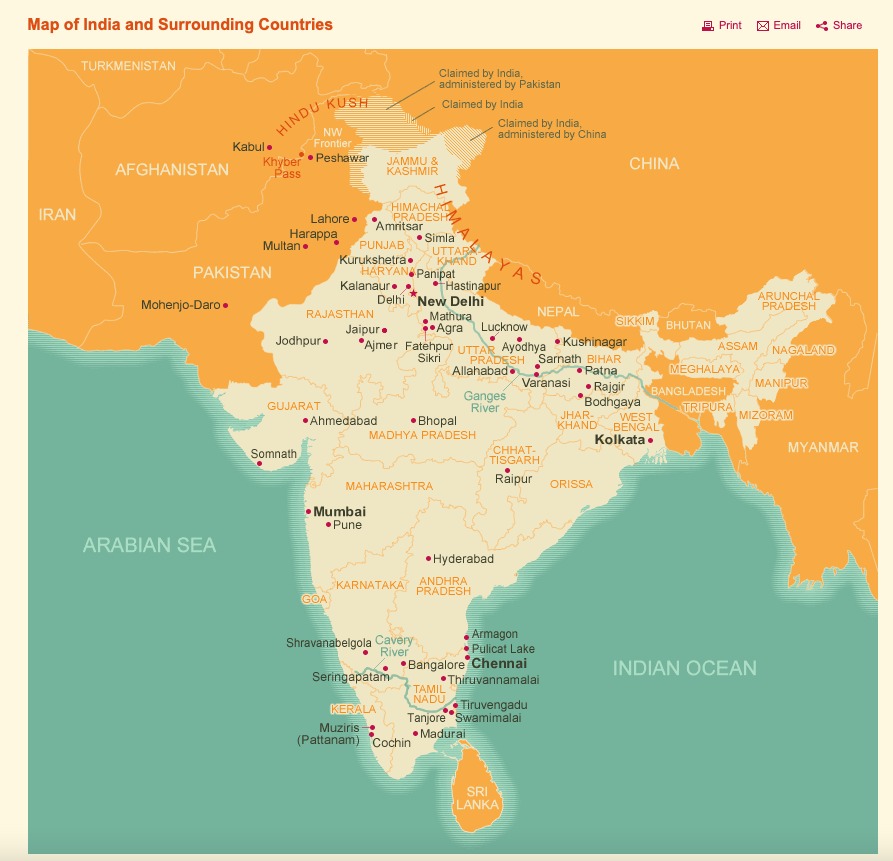
India is the seventh-largest country in the world by area. To help many readers get oriented, the country is shaped like a piece of pie, with the sharp part pointing south. On either side of the pie exists the Indian Ocean with two arms reaching up – the Arabian Sea enclosing the country to the west, and the Bay of Bengal to India’s east. To the north it is bounded by the Great Himalayas.
Six countries touch on India’s northern “crust” edge: to the NW is Pakistan (3323 km shared border); across the north are China (3488 km) and Nepal (1751 km), and to the northeast are Bhutan (699 km), Bangladesh (4096 km) and Myanmar (1643 km). The country (island) of Sri Lanka is off its south-eastern tip.
Economics
India recently overtook Japan as the world’s fourth largest economy, and is projected to grow at an annual growth rate north of 7% this year. India is the world’s largest developing country (a claim that used to belong to China).
There are about 300 million people in the urban middle class with some level of disposable income. “You compare (India) with other geographies, other economies, the first thing that hits you is scale” said Aditya Joshi, Brookfield Asset Management’s country head for India.
India is now making it attractive for business, opening up certain sectors for investments, and creating bilateral ties with global countries. Already it’s happening. Restaurant Brands International, which owns Tim Hortons, plans to increase the number of their locations to 300.
This leads to one of my “subjects” of this blog, the fun Brendan and I had in participating in events that Dylan is engineering in India – the introduction of the Mary Brown Chicken franchise into the country.
Demography
India is the most populated country in the world as of 2026, with a population exceeding 1.4 billion people, having surpassed China in 2023. India’s working age population may exceed China’s by 200 million. India’s population will still be growing in 2040, when China’s will be in rapid decline. By that time about 12% of India’s population will be over 65 (compared with about 24% of China’s).
India has its own demographic and human resource problems, and compared to China it still has poor public health indicators, low average educational attainment, and high levels of illiteracy. Also, despite years of attempted reforms, the country still ranks 131st out of 177 countries on the Heritage Foundation’s Index of Economic Freedom.
Religion
India is both a deeply religious as well as secular nation.
It is characterized by immense diversity, with Hinduism followed by approximately 79.8% of the population. Islam is the largest minority (14.2%), followed by Christianity (2.3%), Sikhism (1.7%), Buddhism (0.7%), and Jainism (0.4%), based on 2011 census data.
Regardless of numbers, it is the birthplace of four major religions: Hinduism, Buddhism, Jainism, and Sikhism. It is home to the world’s largest populations of Hindus, Sikhs, Jains, and adherents of the Bahá’í Faith.
Specifically:
- Hinduism: The majority faith, with high belief in karma and the sanctity of the Ganges River
- Islam: India has one of the world’s largest Muslim populations, with significant numbers in states like Jammu & Kashmir, Assam, and West Bengal. It’s predominantly Sunni
- Christianity: Significant populations are found in Southern India
- Sikhism: Mostly concentrated in the state of Punjab
- Buddhism and Jainism are rooted in ancient India, with smaller, significant populations today
- Roughly 0.27% identified as having “no religion,” a category that includes atheists, agnostics, and rationalists
The Indian Constitution declares the country a secular state, treating all religions equally.
Ken
Your map graphic – https://powellponderings.com/wp-content/uploads/2026/03/PastedGraphic-1.tiff doesn’t show because most browsers don’t display TIFF images in an [Image blocked: No description] tag. The file extension .tiff/.tif isn’t supported by major browsers (Chrome, Firefox, Edge, Safari) for inline rendering, so the tag will fail to show the image. Suggest you convert the image to a web-friendly format (JPEG, PNG, WebP) – and delete this comment 😉
Respectfully,
-Ian
Thanks Ian; I have used a JPEG version and actually chose a better map, Ken